We’ll define \(x\) by specifying its binary expansion. We begin by writing down all possible finite binary strings:
\begin{equation*}
0,\,1, \:\: 00,\,01,\,10,\,11, \:\: 000,\,001,\,010,\,011,\,100,\,101,\,110,\,111,\ldots
\end{equation*}
We then concatenate these to obtain the binary representation of \(x\)
\begin{equation*}
x = 0_{\dot 2}0\,1\,00\,01\,10\,11\,000\,001\,010\,011\,100\,101\,110\,111\ldots
\end{equation*}
Now, let \(I\subset H\) be an open interval. We claim that there is some iterate of \(x\) in \(I\text{.}\) To see that, let \(L\) denote the length of \(I\) and choose \(n\in\mathbb N\) large enough so that
\begin{equation*}
\frac{1}{2^n} < \frac{1}{2}L.
\end{equation*}
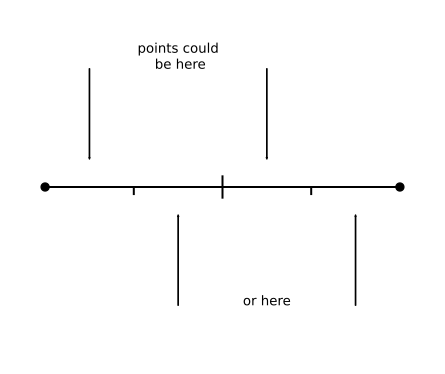
Let \(i\) be the smallest integer such that \(i/2^n \in I\text{.}\) Note that we must also have \((i+1)/2^n \in I\text{.}\) Thus, the dyadic interval \([i/2^n,(i+1)/2^n)\) is wholly contained in \(I\) and the first \(n\) bits of every point in that interval agree with \(i/2^n\text{.}\) So, let
\begin{equation*}
\frac{i}{2^n} = 0_{\dot 2}b_1 b_2 \cdots b_n
\end{equation*}
and note that, by construction, the string \(b_1 b_2 \cdots b_n\) appears somewhere in the binary expansion of \(x\text{.}\) Thus, we can apply the doubling function to the point \(x\) some number, say \(m\text{,}\) times to obtain
\begin{equation*}
d^m(x) = 0_{\dot 2}b_1 b_2 \cdots b_n \cdots.
\end{equation*}
The number \(d^m(x)\) is then an iterate of \(x\) that lies in \(I\text{.}\)