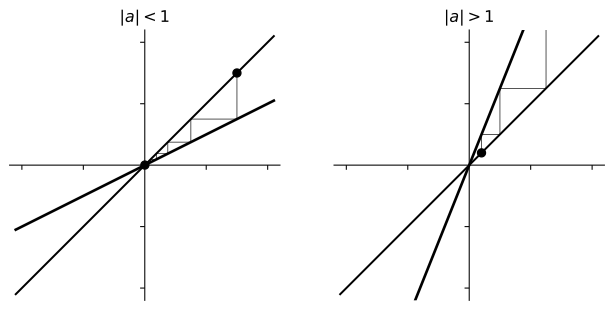
The cobweb plots in the previous section illustrate that the slope of the function at the point where it crosses the fixed point might play a role in the behavior of the iterates near that fixed point. We explore that further here. First, we explore the simplest situation - functions with constant slope.
Suppose that \(f\) is a linear function: \(f(x)=ax\text{.}\) It’s easy to see that the origin \(x=0\) is a fixed point of \(f\text{.}\) Show that any non-zero initial point \(x_0\) moves away from the origin under the iteration of \(f\) whenever \(|a| > 1\) but moves towards the origin under iteration of \(f\) if \(|a| < 1\text{.}\)
This is easy, once we recognize that there is a closed form for the \(n^{\text{th}}\) iterate of \(f\text{,}\) namely \(f^n(x) = a^n x\text{.}\) Note that cobweb plots for these functions are shown in Figure 2.13.
Suppose, that \(f\) is an affine function, which just means that it has the form \(f(x)=ax+b\text{,}\) where \(a\neq 0\text{.}\) Suppose also that \(x_0\in\mathbb R\) and let’s consider the iterates \(x_{n+1} = f(x_n)\)
Example Example 2.12 and exercise Checkpoint 2.14 together classify the dynamical behavior of first order polynomials completely and show that their behavior is fairly simple. For that reason, we focus on polynomials of degree two and higher. Already in the quadratic case, we can find much more complicated and interesting behavior. Motivated by the behavior we see in linear and affine functions, we make the following definition.
Let \(f:\mathbb R \to \mathbb R\) be continuously differentiable and suppose that \(x_0\in\mathbb R\) is a fixed point of \(f\text{.}\) Then we classify \(x_0\) as
The number, \(f'(x_0)\) is called the multiplier for the fixed point. If, in the attractive case, the multiplier is zero, we say that \(x_0\) is super-attractive.
Let \(f:\mathbb R \to \mathbb R\) be continuously differentiable and suppose that \(x_0\in\mathbb R\) is a fixed point of \(f\text{.}\)
If \(x_0\) is an attractive or super-attractive fixed point for \(f\text{,}\) then there is an \(\varepsilon > 0\) such that the orbit of \(x\) under iteration of \(f\) tends to \(x_0\) for every \(x\) such that \(|x-x_0| < \varepsilon\text{.}\)
If \(x_0\) is a repelling fixed point for \(f\text{,}\) then there is an \(\varepsilon > 0\) such that the orbit of \(x\) under iteration of \(f\) tends (initially) away from \(x_0\) for every \(x\) such that \(0 < |x-x_0| < \varepsilon\text{.}\)
We prove part one; the second part is similar. Since \(|f'(x_0)|<1\) and \(f'\) is continuous, we may choose an \(\varepsilon>0\) and a positive number \(r<1\) such that \(|f'(x)|<r\) for all \(x\) such that \(|x-x_0| < \varepsilon\text{.}\) Then, given \(x\) such that \(|x-x_0| < \varepsilon\text{,}\) we can apply the Mean Value Theorem to obtain a number \(c\) such that
From the proof, we see that \(x_n\to x_0\) exponentially and that the magnitude of \(|f'(x_0)|\) dictates the base of that exponential. When \(f'(x_0)=0\text{,}\) the rate is faster than exponential.
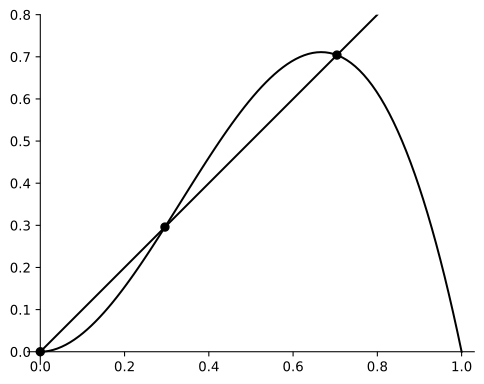
The function \(f(x)=4.8\,x^2(1-x)\) is graphed in Figure 2.18, along with the line \(y=x\text{.}\) The points of intersection are fixed points and, from left to right, they are super-attractive, repulsive, and attractive. The reader should consider the appearance of a cobweb plot for initial values starting near each of those fixed points.
Checkpoint2.19Dynamical behavior near neutral fixed points.
For each of the following scenarios, find an example of a function \(f:\mathbb R\to \mathbb R\) and a fixed point \(x_0\) of \(f\) satisfying that scenario.
There is an \(\varepsilon > 0\) such that the orbit of \(x\) tends initially away from \(x_0\) for all \(x\) such that \(0 < |x-x_0| < \varepsilon\text{.}\)
There is an \(\varepsilon > 0\) such that the orbit of \(x\) tends to \(x_0\) for all \(x\) such that \(0 < x-x_0 < \varepsilon\) but the orbit of \(x\) tends initially away from \(x_0\) for all \(x\) such that \(0 < x_0-x < \varepsilon\text{.}\)
There is an \(\varepsilon > 0\) such that the orbit of \(x\) tends to \(x_0\) for all \(x\) such that \(0 < x-x_0 < \varepsilon\) but the orbit of \(x\) tends initially away from \(x_0\) for all \(x\) such that \(0 < x_0-x < \varepsilon\text{.}\)