Subsection 2.10.2 Escaping orbits
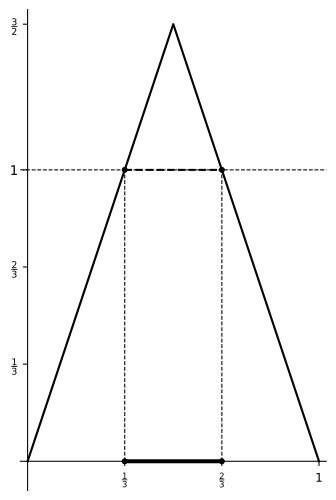
We now begin our investigation of the tall tent map \(T_3\text{,}\) whose graph is shown in Figure 2.54. We see there the critical issue that the unit interval is no longer invariant. As we see, the open interval \((1/3,2/3)\) maps to values larger than \(1\text{.}\)
As it turns out, there is a very important invariant set that leads us naturally to the study of fractal geometry. To find it, we’ll continue to iterate \(T_3\) to see what other points might escape. To that end, the graphs of \(T_3^2\) and \(T_3^3\) are shown in
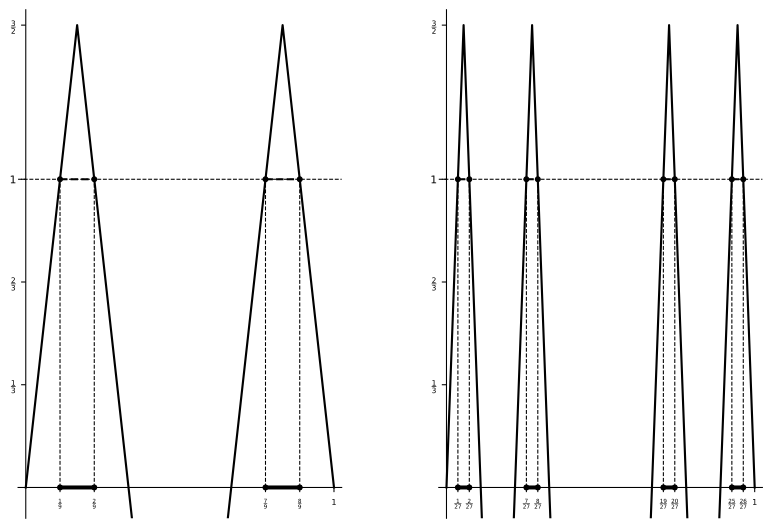
Note that the middle third has escaped from each of the closed intervals \([0,1/3]\) and \([2/3,1]\) that remained after the first iteration, leaving us with four intervals
\begin{equation*}
[0,1/9],[2/9,1/3],[2/3,7/9], \text{ and } [8/9,1].
\end{equation*}
A similar process happens after the next step and, generally, after the \(n^{\text{th}}\) step. Let us denote the set of all intervals that remain after \(n\) iterations by \(C_n\text{.}\) Then \(C_0\) is the unit interval and
\begin{equation*}
C_1 = [0,1/3] \bigcup [2/3,1].
\end{equation*}
Generally, \(C_n\) consists of \(2^n\) intervals of length \(1/3^n\) and the invariant set for \(T_3\) is exactly
\begin{equation*}
C = \bigcap_{n=0}^{\infty} C_n.
\end{equation*}
It might not seem like there’s much to \(C\) but it turns out to be a very rich set and the prototypical fractal, as we’ll meet in the next chapter. It’s called the Cantor set.

