Subsection 2.7.5 Periodic windows
Amongst the chaos apparent within the bifurcation diagram, there appear to be a number of periodic windows - a range of parameter values where an attractive periodic orbit dominates the behavior. The largest one appears in Figure 2.32 just to the left of \(c=-1.75\) where the third (green) critical curve crosses the horizontal \(c\)-axis. This is the so-called period three window.
Note that the critical curves seem to cross the horizontal \(c\)-axis at exactly the locations of the periodic windows. Corollary 2.22 explains why. Note that \(f_c^n(0)\) crosses the horizontal axis exactly when \(f_c^n(0)=0\text{.}\) Thus, \(0\) is periodic for \(f_c\) with a period that divides \(n\text{.}\)
When \(n=3\text{,}\) for example, this leads to the equation
\begin{equation*}
(c^2 + c)^2 + c = 0.
\end{equation*}
We can find all real roots of this polynomial using the following Sage code: The value of about \(-1.75\) agrees with our observations. The value of zero occurs because zero is a fixed point of \(f_0\) and, therefore, of \(f_0^3\) as well.
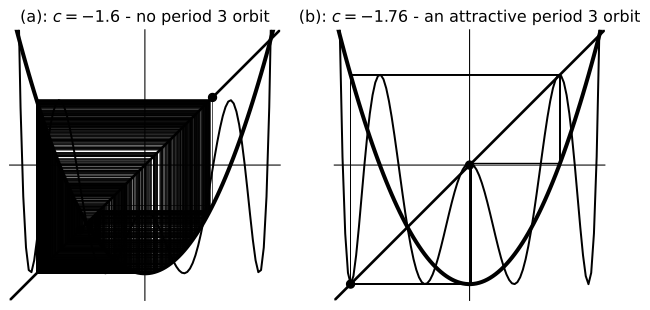
An alternative way to shed light on the sudden occurrence of the period three window is to use cobwebplots as shown in Figure 2.34. In that figure on the left, we see the cobweb plot for \(c=-1.6\) together with the \(3^{\text{rd}}\) iterate \(f_{-1.6}^3\) of \(f\text{.}\) The key observation is that the graph of \(f_{-1.6}^3\) intersects the line \(y=x\) only at the fixed points of \(f_{-1.6}\text{.}\) Thus, there is no orbit of period three for \(c=-1.6\text{.}\) By the time \(c=-1.76\) on the right figure, there is such an orbit.
Note that our interactive cobweb tool can be used to explore this further: https://legacy.marksmath.org/visualization/cobwebs/

