For each positive number \(a\text{,}\) we define the tent map \(T_a\) on \([0,1]\) by
\begin{equation*}
T_a(x) = \begin{cases}
a\,x \amp 0\leq x \leq 1/2 \\
a\,(1-x) \amp 1/2\leq x \leq 1.
\end{cases}
\end{equation*}
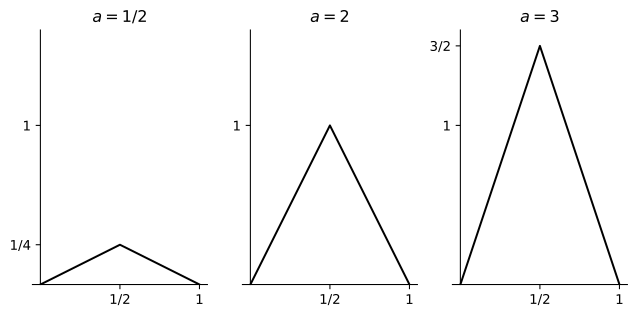
The graphs of several tent maps are shown in Figure 2.49. Note that when \(a < 2\text{,}\) the function \(T_a\) maps \([0,1]\)into itself and that when \(a=2\text{,}\) the function \(T_a\) maps \([0,1]\)onto itself. When \(a > 2\text{,}\) the unit interval is no longer invariant
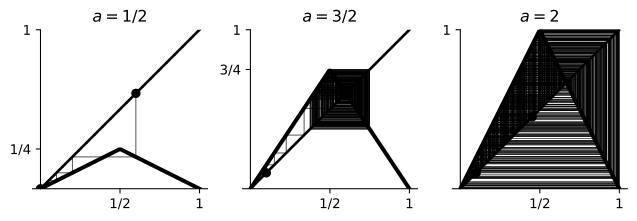
Of course, we are interested in iterating \(T_a\) for various values of \(a\text{.}\)Figure 2.50 shows cobweb plots of tent maps for several choices of \(a\) in the interval \((0,2]\text{.}\) It appears that \(T_a\) should have a single attractive fixed point at the origin when \(a < 1\) and that \(T_a\) should be chaotic on some interval when \(a > 1\text{.}\)
The doubling map \(d\) is semi-conjugate to the tent map \(T_2\) under the semi-conjugacy \(T_2\) itself. Thus, \(T_2\) is chaotic on the unit interval.
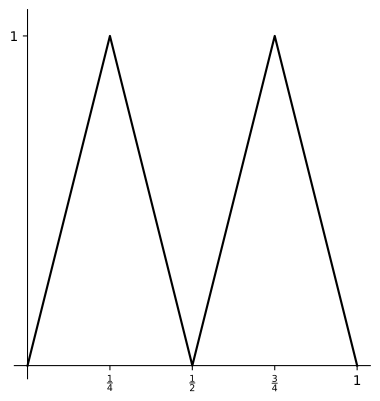
The graph even reveals the common value we should shoot for, namely
\begin{equation*}
T_2 \circ T_2(x) = T_2 \circ d(x) = \begin{cases}
4 x \amp 0 \le x \le \frac{1}{4} \\
4 \left(\frac{1}{2}-x\right) \amp \frac{1}{4} \le x \le \frac{1}{2} \\
4 \left(x-\frac{1}{2}\right) \amp \frac{1}{2} \le x \le \frac{3}{4} \\
4 (1-x) \amp \frac{3}{4} \le x \le 1
\end{cases}.
\end{equation*}
To do so, we simply check that the definitions work out over each subinterval in the piecewise definition. Over the third subinterval \(1/2 \le x \le 3/4\text{,}\) for example, we have
When checking these inequalities, simply check where the output of the inner function lies to ensure that you apply the correct formula for the outer function.
Just as with the chaotic quadratic, Claim 2.51 implies that the tent map \(T_2\) is chaotic. You can apply the conjugacy function \(T_2\) itself to a periodic point of \(d\) to find a periodic point of \(T_2\text{.}\) For example, \(T_2(0_{\dot 2}\overline{001}) = 2/7\) is a period three point for \(T_2\text{,}\) as you can easily check.
In other words, the map shifts the digits (like the doubling map) when the first bit is zero but shifts bits and swaps the remaining bits when the first bit is one.