Skip to main content
Contents
Search Book
Search Results:
No results.
Read aloud Readability settings Prev Up Next \(\newcommand{\N}{\mathbb N}
\newcommand{\Z}{\mathbb Z}
\newcommand{\Q}{\mathbb Q}
\newcommand{\R}{\mathbb R}
\newcommand{\lt}{<}
\newcommand{\gt}{>}
\newcommand{\amp}{&}
\definecolor{fillinmathshade}{gray}{0.9}
\newcommand{\fillinmath}[1]{\mathchoice{\colorbox{fillinmathshade}{$\displaystyle \phantom{\,#1\,}$}}{\colorbox{fillinmathshade}{$\textstyle \phantom{\,#1\,}$}}{\colorbox{fillinmathshade}{$\scriptstyle \phantom{\,#1\,}$}}{\colorbox{fillinmathshade}{$\scriptscriptstyle\phantom{\,#1\,}$}}}
\)
Exercises 1.3 Exercises
This set of exercises will be mostly experimental. So, fire up your favorite computational environment. There are lots of potential choices but this text will generally present examples using Sage.
1. Continuing with the example of
\(f(x)=x^2-2\) explored in
Example 1.3 , compute ten Newton iterations for several values of
\(x_0\text{.}\) Be sure to choose both positive and negative values and values that are both large and small in magnitude.
2. In the previous exercise, what happens when
\(x_0=0\text{?}\) Draw a graph to illustrate the situation.
3. Let
\(f\) be a quadratic function that has two, distinct, real roots but that is otherwise arbitrary. Using a geometrical understanding of the real Newton’s method, show why an initial seed
\(x_0\) other than the midpoint between the roots always leads to a sequence that converges to the closer of the two roots of
\(f\text{.}\)
4.
Let’s modify Newton’s original example just a little bit to consider
\begin{equation*}
f(x) = x^3-2x-2.
\end{equation*}
Compute the corresponding Newton’s method iteration function, \(N\text{.}\)
Iterate \(N\) from the initial point \(x_0 = 0\text{.}\) What behavior do you see?
Iterate \(N\) from several initial points \(x_0\) close to zero. Now, what behavior do you see?
5.
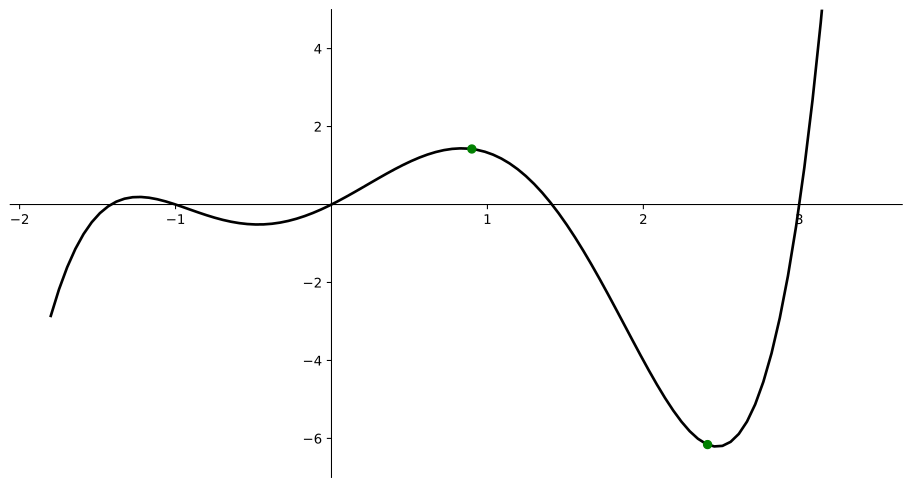
\begin{equation*}
f(x) = \frac{1}{3} x (x + 1) (x - 3) (x^2 - 2).
\end{equation*}
The green dots represent points on the graph with \(x\) -coordinates that we might consider as initial seeds for Newton’s method.
Suppose we start at the green dot whose \(x\) coordinate is just slightly larger than 1. To which root do you think the process will converge?
Suppose we start at the green dot whose \(x\) coordinate is between 2 and 3. To which root do you think the process will converge?
Find a specific value of the initial seed \(x_0\) between 2 and 3 with the property that the process converges to the smallest root of the function.
Find a specific value of the initial seed \(x_0\) between 2 and 3 with the property that the process converges to the value \(-1\text{.}\)
6. Now, use the tool to generate images for the following polynomials and answer any additional questions that are asked.
\(f(z) = z^4 - 1\)
What are the four roots of the function? Where do they fit into the picture?
Click on the picture. How do you interpret the line that is drawn?
\(f(z) = (z^2-1)(z-10)\)
What initial step should you take to enter your input?
What are the roots of the function? How could you account for this when generating the picture?
\(f(z) = z^3 - 2z - 2\)
You should see some black regions. What’s up with that?
Figure 1.24. The graph of the function for problem 5