Use the triangle inequality to show that \(|g_{\lambda}(z_0)| \geq |z_0|\text{,}\) whenever \(|z_0| \gt \max(2,2|\lambda|)\text{.}\) Conclude that the orbit of \(z_0\) escapes whenever an iterate exceeds \(\max(2,2|\lambda|)\text{.}\)
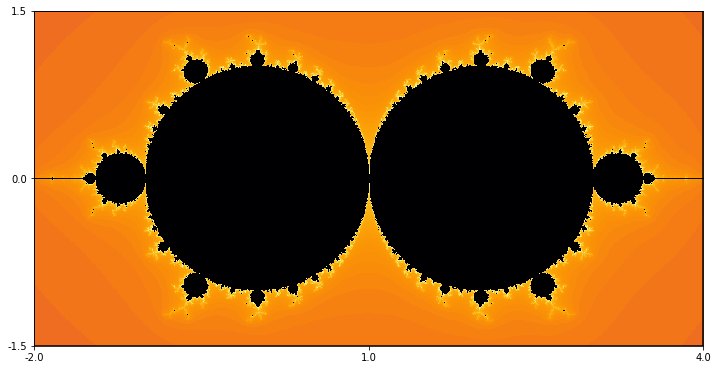
The escape locus for \(g_{\lambda}\) (or any family of quadratics) is a partition of the complex parameter plane into two regions - one where the critical orbit stays bounded and one where the critical orbit diverges. This escape locus is shown in figure Figure 3.23. Let’s try to understand a couple of things about this image.
Show that the origin is an attractive (or super-attractive) fixed point of \(g_{\lambda}\text{,}\) whenever \(|\lambda| \lt 1\text{.}\) This observation yields what prominent feature in figure Figure 3.23?