As mentioned right after the example on periodicity 2.6, a periodic point for \(f\) of period \(n\) is a fixed point of \(f^n\text{.}\) Treating the points of a periodic orbit this way allows us to extend the classification of fixed points to periodic orbits.
Let \(f:\mathbb R \to \mathbb R\) be continuously differentiable and suppose that \(x_0\in\mathbb R\) is a periodic point of \(f\) with period \(n\text{.}\) Let \(F=f^n\text{.}\) We classify \(x_0\) and its orbit as
The number \(F'(x_0)\) is called the multiplier of the orbit. If, in the attractive case, the multiplier is zero, we say that the orbit is super-attractive.
Let \(f(x) = x^2-1\text{.}\) Note that \(f(0)=-1\) and \(f(-1)=0\) so that \(0\to-1\to0\) forms an orbit of period 2. To see if this orbit is attractive, we examine
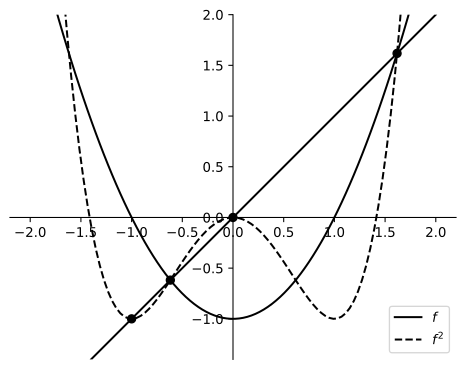
The plots of \(f\) and \(f^2\text{,}\) together with \(y=x\text{,}\) are shown in Figure 2.24. Note that \(f\) has two fixed points shown in red. They can be found by solving the equation \(x^2-1=x\) and they are both repulsive under iteration of \(f\text{.}\) The two super-attractive orbits of \(f^2\) are shown in green.