Summary of Coordinate Systems
Here’s a summary of the three new types of coordinate systems (polar, cylindrical, and spherical) that we’ve seen for integration. There’s also a couple of example problems of each for us to try together.
Polar coordinates
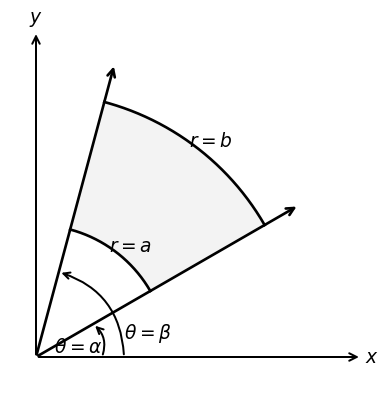
Works great with regions bound by circular arcs centered at the origin and rays emanating from the origin:
These types of regions have bounds like \[a\leq r \leq b \text{ and } \alpha \leq \theta \leq \beta,\] which correspond to double integrals that translate like \[ \color{green}{\iint_R} \color{blue}{f(x,y)} \, \color{red}{dA} \: \color{black}{\to} \: \color{green}{\int_{\alpha}^{\beta} \int_a^b} \color{blue}{F(r,\theta)} \: \color{red}{r \, dr \, d\theta}, \] where \[F(r,\theta) = f(r\cos(\theta), r\sin(\theta))\] or just \(r^2 = x^2 + y^2\).
Polar examples
Polar coordinates might help for integrals like
- \(\displaystyle \iint\limits_D (4-(x^2+y^2)) \, dA\) where \(D\) is the portion of the disk of radius 2 centered at the origin that lies in the first quadrant.
- \(\displaystyle \iint\limits_{D_R} e^{-(x^2+y^2)} \, dA\) where \({D_R}\) is the disk of radius \(R\) centered at the origin.
Cylindrical coordinates
Cylindrical coordinates look a lot like polar coordinates + \(z\). The work great with spatial regions that are extrusions of polar regions along the \(z\)-axis, like so:
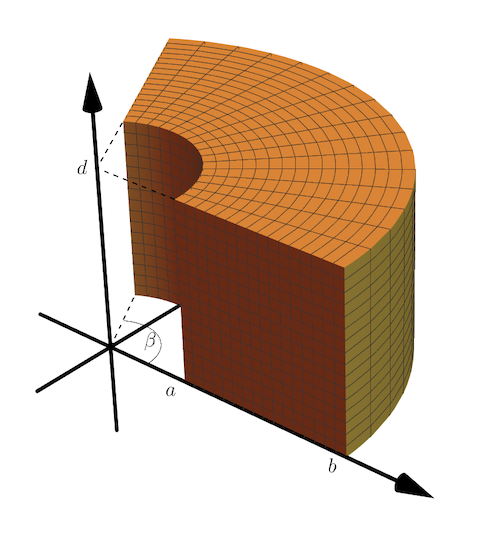
This type of region has bounds like \[ a \leq r \leq b, \quad \alpha \leq \theta \leq \beta, \quad c \leq z \leq d. \] We can set this up as an iterated integral like so: \[ \color{green}{\iiint_R} \color{blue}{f(x,y,z)} \, \color{red}{dV} \color{black}{=} \color{green}{\int_{\alpha}^{\beta} \int_c^d \int_a^b} \color{blue}{f(r\cos(\theta), r\sin(\theta), z)} \, \color{red}{r \, dr \, dz \, d\theta} \]
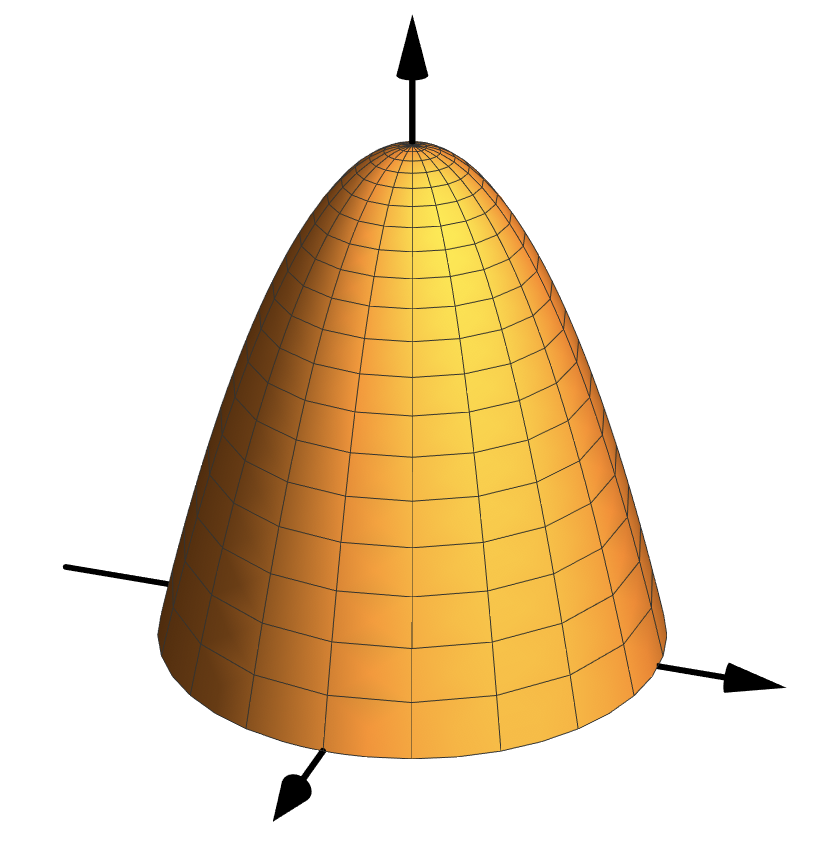
Things shouldn’t be too complicated if the \(z\) bounds involve functions of \(r\) and \(\theta\), to get a region like \[ a \leq r \leq b, \quad \alpha \leq \theta \leq \beta, \quad g(r,\theta) \leq z \leq h(r,\theta). \] An example there could be \[ \{(r,\theta,z): 0 \leq z \leq 4-r^2\}, \] which looks like
Cylindrical examples
- Let \(R\) denote the region in the first octant contained in the cylinder of radius \(2\) centered on the \(z\) axis and bound above by \(z=5\). Compute \[\iiint\limits_R (2x^2 + 2y^2 + z) \, dV.\]
- Let \(R\) denote the region bound between the paraboloid \(z=x^2+y^2\) and the plane \(z=9\). Set up \[\iiint\limits_R f(x,y,z) \, dV\] as an iterated integral in cylindrical coordinates.
Spherical coordinates
Spherical coordinates work well with regions bound by portions of spheres centered at the origin. Here’s one example:
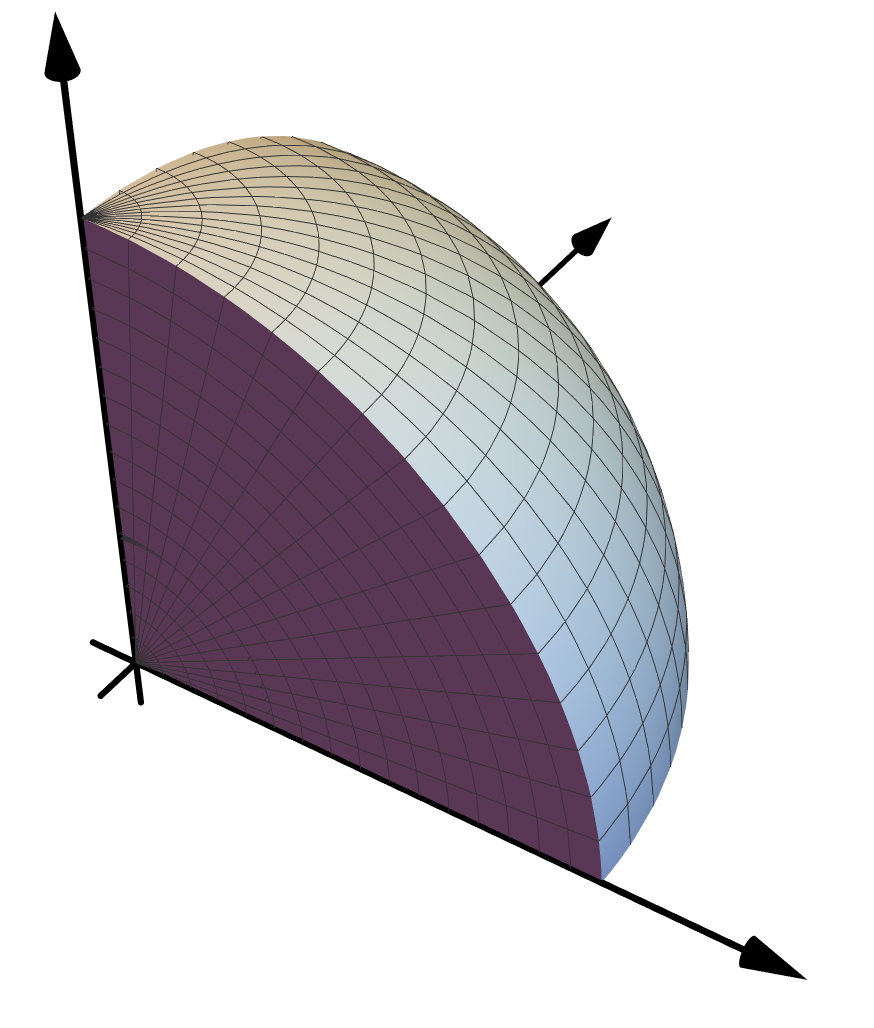
These regions have the form \[ \alpha \leq \theta \leq \beta, \quad \gamma \leq \varphi \leq \delta, \quad a \leq \rho \leq b. \]
When setting this type of integral up, remember that
- \(\rho\) denotes the distance to the origin,
- \(\varphi\) denotes the angle from the positive \(z\)-axis,
- \(\theta\) denotes the usual polar angle.
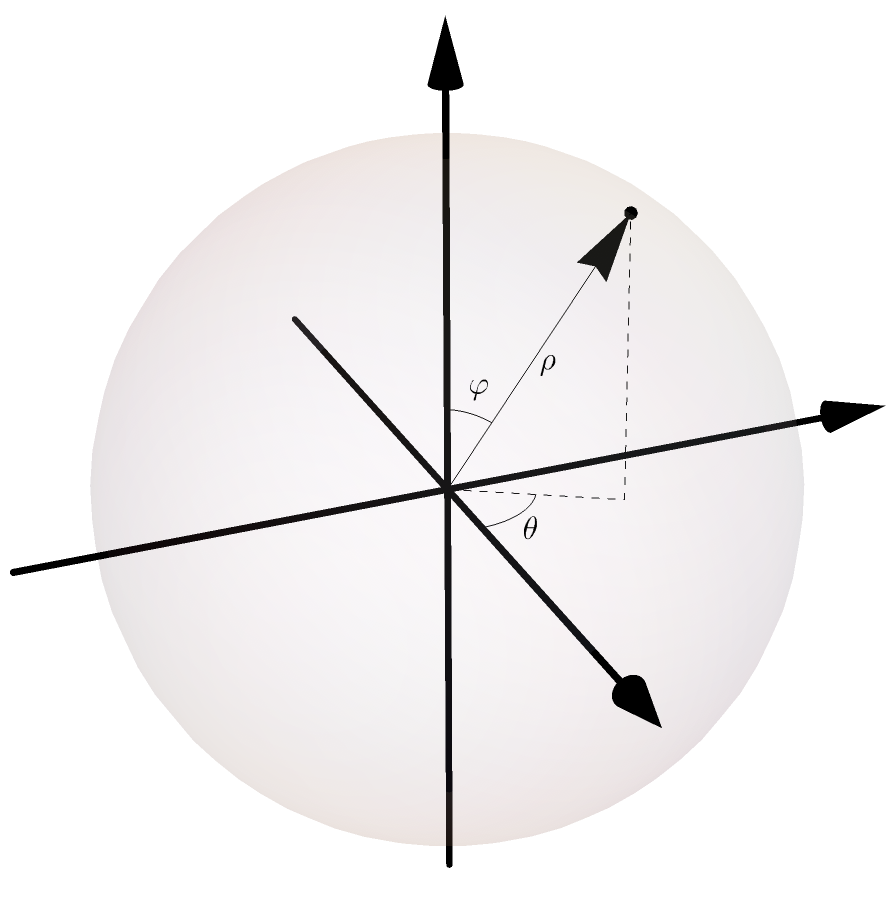
We can set up an integral over a region like this via \[ \color{green}{\iiint_R} \color{blue}{f(x,y,z)} \, \color{red}{dV} \color{black}{=} \color{green}{\int_{\alpha}^{\beta} \int_{\gamma}^{\delta} \int_a^b} \color{blue}{f(\rho\sin(\varphi)\cos(\theta), \rho\sin(\varphi)\sin(\theta), \rho\cos(\varphi))} \, \color{red}{\rho^2 \sin(\varphi)\, d\rho \, d\varphi \, d\theta}. \] Often, the integrand depends on \(x^2+y^2+z^2\), which can be translated directly to \(\rho^2\).
Spherical examples
- Let \(R\) denote the region inside the sphere is radius \(2\), outside the sphere of radius \(1\), and above the \(xy\)-plane. Evaluate \[\iiint\limits_R (x^2+y^2+z^2)^3 \, dV.\]
- Let \(R\) denote the region inside the unit sphere. Evaluate \[\iiint\limits_R (x^2+y^2+z^2) \, dV.\]