MML - Practice for Exam 3
We will have our third exam this Friday! Here’s our in class practice sheet.
The problems
Suppose that \(X\) has the continuous distribution \[ f(x) = \frac{1}{2} x \] over the interval \([0,2]\)
- Write down the computation that shows that \(f\) is a good probability distribution.
- Use an integral to compute the mean of \(X\).
- Using your computed mean from part (b), write down the integral that expresses the variance of \(X\).
Use \(u\)-substitution to translate the normal integral \[\frac{1}{\sqrt{50\pi}}\int_2^6 e^{-(x-3)^2/50}\,dx\] to a standard normal integral.
I’ve got a coin that might very well be unfair. Suppose I flip that coin 200 times and I get 60 heads.
- Based on that evidence, what’s your best guess of the probability \(p\) that the coin comes up heads?
- Given a value of \(p\), use the binomial distribution to write down a function \(f(p)\) that expresses the probability that the coin comes up heads 60 times in 200 flips.
- Use calculus to find the value of \(p\) that maximizes \(f\).
Find the eigenvalues and corresponding eigenvectors of \[A = \left[\begin{array}{rr}3 & 1 \\ -2 & 0\end{array}\right].\]
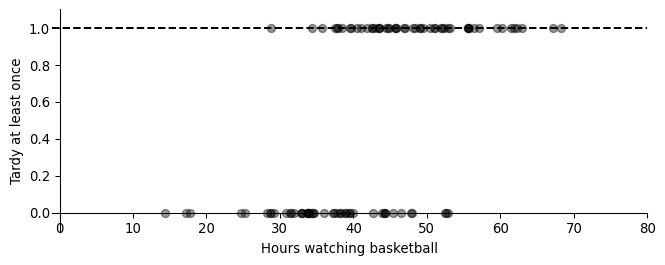
Let’s suppose that excessive basketball watching causes tardiness. To study this problem, I collected data on 100 people. Below we see this data plotted and in a partial table.
Hours in March Late at least once 55 1 46 0 52 1 24 0 \(\vdots\) \(\vdots\) - Suppose we model this data using logistic regression. What is the primary objective?
- Logistic regression produces an estimator function that you use to achieve your objective. When we have one input variable (as in this case), the estimator function depends upon two parameters - \(a\) and \(b\). Write down the general formula for the estimator in terms of the parameters \(a\) and \(b\).
- Suppose I have the three candidate pairs of values of \(a\) and \(b\) shown in Table 1 together with their associated log-loss. Which candidate pair \((a,b)\) should I use for my estimator?
- What is the resulting probability estimate that an individual who watched 55 hours of basketball in March was late to work or school at least once during that time?
- Sketch a rough graph of your probability estimator function right on top of the plot.
Table 1: LR parameter candidates and their log-loss \(a\) \(b\) Log-loss 0.152 7.34 0.959 0.23 966 0.828 0.108 5.94 1.401