mark
You can ask questions about our review for exam 2 by posting them here!


You can ask questions about our review for exam 2 by posting them here!

For problem 2.a, would it be acceptable to answer something along the lines of "Individual NBA Players"
And for 2.d would "N/A" or "none" work as well?
Instead of using the definition of linear dependence to define linear independence, would the following work instead?
We say that a set of vectors
is linearly independent if the equation
has only the trivial solution (that is, all \alpha_i = 0).
Yes - that's great!!

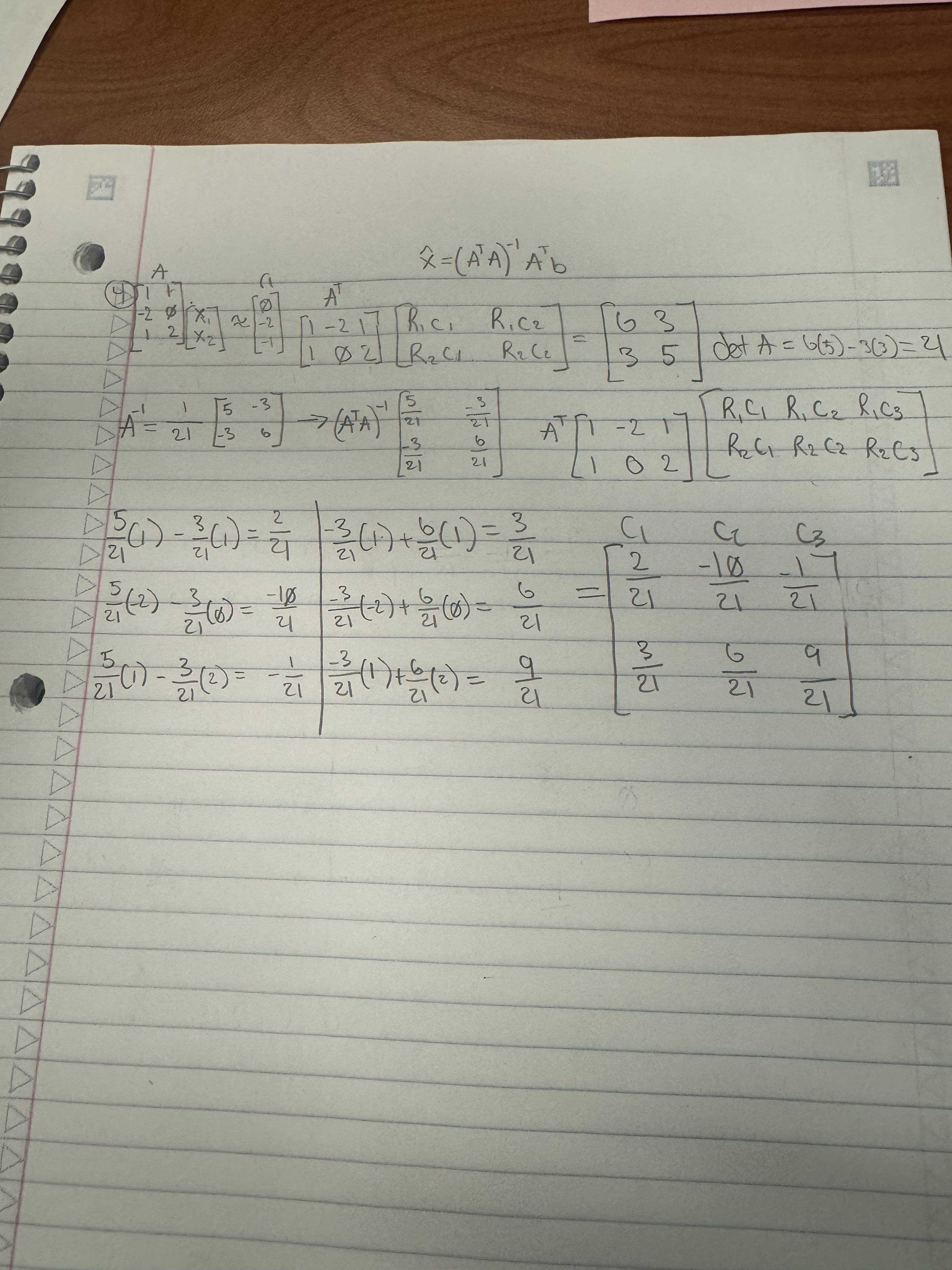
I guess the problem is to find the least squares solution to the overdetermined linear system
The general technique is to solve the problem using the normal equations
You've written that as
I guess you've multiplied both sides by (A^T A)^{-1} to solve for \hat{x}.
I strongly recommend against that. The matrix inverse is a useful theoretical tool for reasoning about systems. It is rarely used in computations because it leads to far too many arithmetic operations.
The recommended way to solve
is via Gaussian elimination. Thus, write out those equations in full matrix form:
Then expand the products to get
That system is not hard to solve. You could write it as a single augmented matrix or even just as a 2\times2 system:
I'll leave it to you guys to solve that system!
For question 3 and 6 are you looking for proofs? Can you please provide an example if so.
Question 3 asks
- Consider the numeric data \{1,2,4,4\}.
a. Write down the computation showing that the mean is 2
b. Write down the computation showing that the standard deviation is \sqrt{3/2}.
I literally expect you to write down
and
I would not call that a proof; it's a computation with the formula made explicit.
My apologizes I meant 3 and 6 on the work sheet you handed out in class Wednesday.
Question 6 asks
Show that the null space of a linear transformation mapping \mathbb R^n \to \mathbb R^m is closed under linear combinations and is, therefore, a subspace of \mathbb R^n.
Let T:\mathbb R^n \to \mathbb R^m be a linear transformation and let \vec{u} and \vec{v} be in the nullspace of T. That means that
Now, let \alpha,\beta\in\mathbb{R} be scalars. Then, by linearity of T,
Thus, \alpha\vec{u} + \beta\vec{v} is also in the nullspace of T so that the nullspace is closed under linear combinations.\Box
I thought you might've! Number 6 off the review sheet is a good example of a proof, too, and I've just responded to that.

When it comes to providing a basis for null space and range for question 5, what exactly are we expected to write?
When you're doing Gaussian elimination, aren't the 2's supposed to be negative still for
and