mark
You can ask questions about our review for exam 1 by posting them here!


You can ask questions about our review for exam 1 by posting them here!

The answers to number 6 seem to be:
a)
b)
Yes, I largely agree! Note that I did strike out your last equation z=z. I mean, it's hard to argue against that but the typical way that folks phrase that is to that "z is free".
I think the preferred way to write it is that the solution set is
One final comment: On the exam itself, you show your work using notational steps like
I understand, of course, that typing that out in the forum is a skill we haven't really developed and am not expecting it here. I just want to make the expectations on the exam clear.
If z is free, can I just not write that and write the x and y equations as I've had them on the exam? I'm more referring to the format of the equation.
Well, there's a whole infinite set of solutions, which why I often refer to the "solution set" and write it in set theoretic notation like
If you'd like to incorporate your equations, you could write the solution as
The set of (x,y,z) such that
x=-2z+4 \text{ and } y = -z+2.
Again, the solution is not a set of equations; it's a set of points in 3D space defined by a set of equations.
I'll be using the second option then. That one is easier to remember.

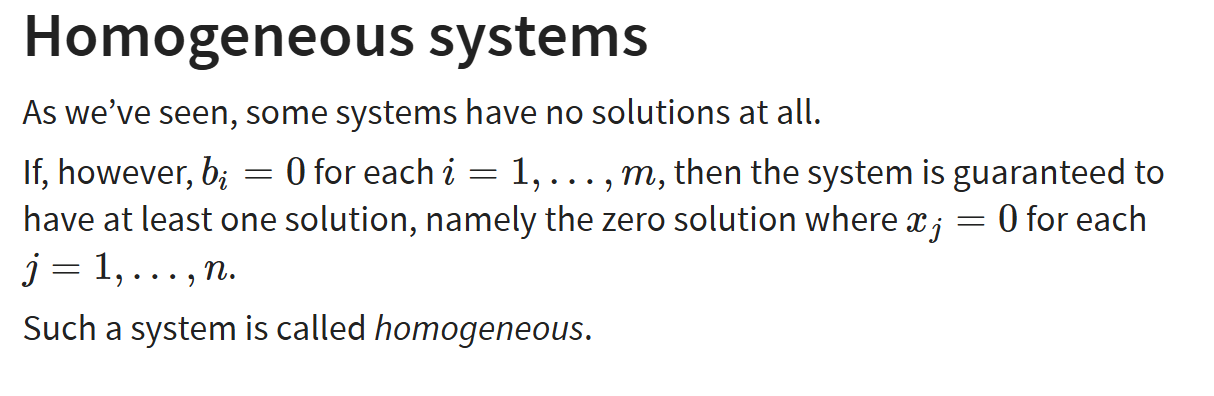
In regards to the definition question you will be asking us specifically on "Homogeneous System". Are you expecting us to remember the entire slide or the first sentence? I ask this clarifying question because the other key terms to remember had a solid one sentence definition that seemed suitable and the first sentence on this term seemed a bit vague for what you might expect on an exam.
Hmm... Yes, I agree that does look a bit vague. Let's just reorder things a bit:
An m\times n system A\vec{x}=\vec{b} is called homogeneous when \vec{b} is the zero vector \vec{b}=\vec{0}.
To be clear, that's a solid and complete definition using the matrix notation that we've developed since first meeting the concept. If you want to refer to a full system, you could write:
An m\times n system
\begin{aligned} a_{11} x_1 + a_{12} x_2 + \cdots + a_{1n} x_m &= b_1 \\ a_{21} x_1 + a_{22} x_2 + \cdots + a_{2n} x_m &= b_2 \\ \vdots \hspace{5mm} + \hspace{5mm} \vdots \hspace{6mm} + \hspace{0.3mm} \ddots \hspace{0.5mm} + \hspace{6.7mm} \vdots \hspace{6mm} &= \hspace{2mm} \vdots \\ a_{m1} x_1 + a_{m2} x_2 + \cdots +a_{mn} x_m &= b_m \end{aligned}is called homogeneous if b_i = 0 for every i.
Either of the above formulations is fine.