mark
Suppose that A and B are both nonsingular matrices of the same size. Show that
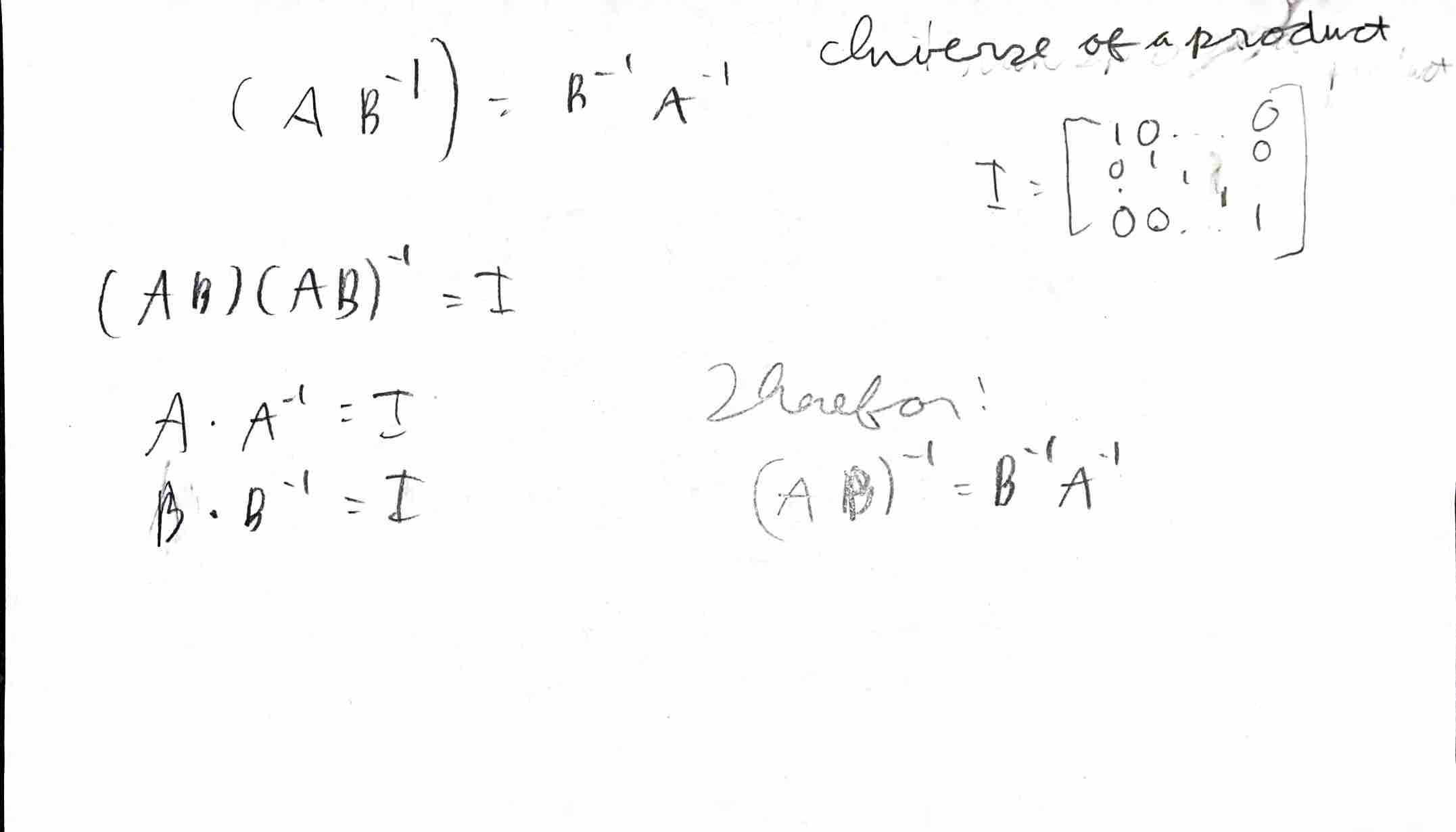
(AB)^{-1} = B^{-1}A^{-1}.
Hint: What should you get if you multiply AB by (AB)^{-1}?
:thinking: 1


Suppose that A and B are both nonsingular matrices of the same size. Show that
Hint: What should you get if you multiply AB by (AB)^{-1}?

Multiplication of AB by (AB)^{-1} should result in the identity matrix, I. I'm not sure where to go after that. Maybe show that B^{-1}A^{-1} multiplied by AB is also I?
Yes - I agree. I guess the first step would be write it down! Of course, the associative property says that you can group then any way you want.
@User 029 I think you might be onto something here! I particularly like the line that looks like
I guess that the next question would then be, does
also equal I?
Please use the typesetting features, though - rather than uploading images. Writing with LaTeX is a valuable skill that are learning. It also forces you to write in a linear fashion that is part of mathematical communication.
And, don't forget that you can use the proofreader, too!

Multiplication is associative by nature, so:
Matrix multiplication is not commutative.
It is, however, associative. Thus, I really like this bit here:
Associativity implies that you can drop those parentheses and re-parenthesize in any grouping you like. You can't change the order of the matrices, though.
After you drop the parentheses, you get
Can you see how you might re-parenthesize from here to get the next step?