Falling and work
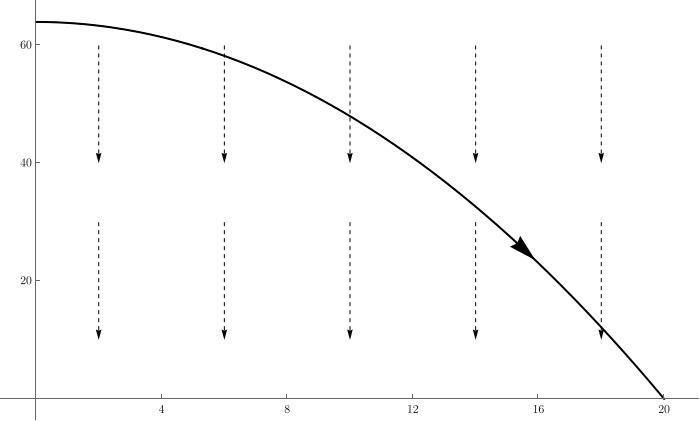
Suppose we shoot a 1kg object horizontally off of a platform that’s 64 feet high with an initial speed of 10 feet per second.
What is the work done by gravity on this object?
Solution
Using the line integral formulation, the work is
\[
\begin{aligned}
\int_C \mathbf{F} \cdot d\mathbf{r} &=
\int_0^2 \mathbf{F}(\mathbf{r}(t))\cdot\mathbf{r}'(t)\,dt \\
&= \int_0^2 \langle 0, -32 \rangle \cdot \langle 10,-32t \rangle \, dt \\
&= \int_0^2 1024t \, dt = 2048.
\end{aligned}
\]
Explanation
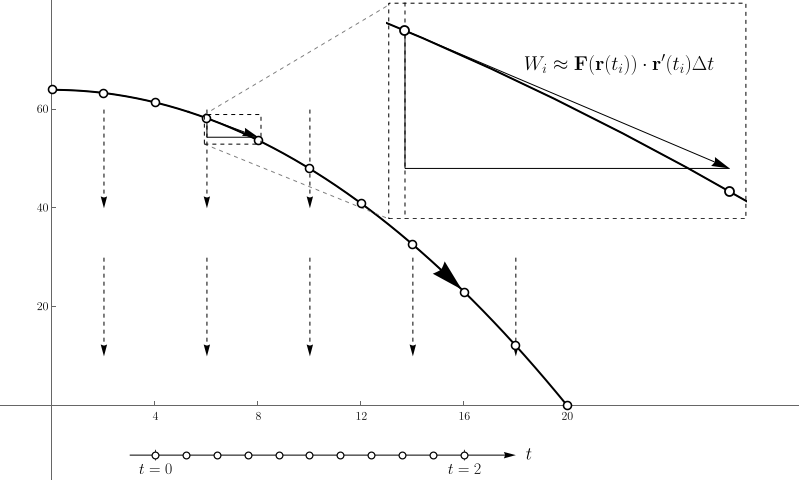
The work required to move the object from one point to the next is approximately \(\mathbf{F}(\mathbf{r}(t_i))\cdot \mathbf{r}'(t_i)\Delta t\). If we add those all up, we get \[
\sum_{i=1}^n \mathbf{F}(\mathbf{r}(t_i))\cdot \mathbf{r}'(t_i)\Delta t \to \int_a^b \mathbf{F}(\mathbf{r}(t))\cdot\mathbf{r}'(t)\,dt.
\]
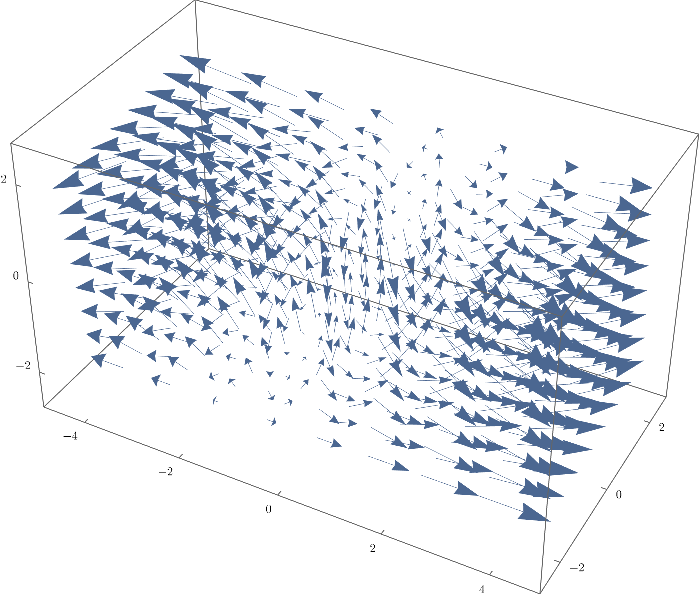
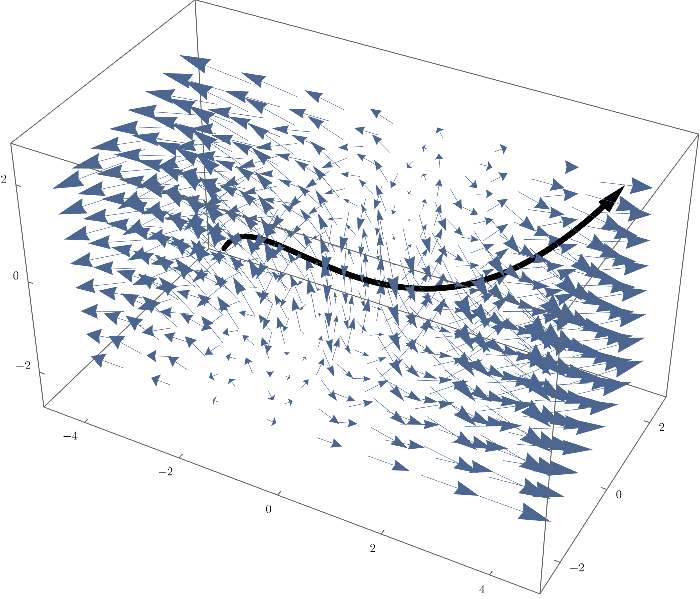
A 3D integral
The path of \(\mathbf{r}(t) = \langle 2 t, t^2, t^3 \rangle\) over the time interval \(-1\leq t \leq 1\) through the vector field \(\mathbf{F}(x,y,z) = \langle x,-z,y \rangle\).
The corresponding line integral
To find the work done by that vector field on an object moving through that path, we evaluate
\[
\int_C \mathbf{F}\cdot d\mathbf{r} =
\int_{-1}^1 \mathbf{F}(\mathbf{r}(t))\cdot\mathbf{r}'(t) \, dt.
\]
Since \(\mathbf{F}(x,y,z) = \langle x,-z,y \rangle\) and \(\mathbf{r}(t) = \langle 2 t, t^2, t^3 \rangle\),
\[\mathbf{F}(\mathbf{r}(t))\cdot \mathbf{r}'(t) = \langle 2t, -t^3, t^2 \rangle\cdot\langle 2,2t,3t^2\rangle = 4t+t^4.\]
Finishing it
Finishing the integral, we get
\[
\begin{aligned}
\int_C \mathbf{F}\cdot d\mathbf{r} &=
\int_{-1}^1 \mathbf{F}(\mathbf{r}(t))\cdot\mathbf{r}'(t) \, dt\\
&= \int_{-1}^1 \left(4t+t^4\right) \, dt = 2/5.
\end{aligned}
\]
Conservative vector fields
A vector field \(\mathbf{F}\) is called conservative if it arises as the gradient of a real valued function. That is, there is a function \(f:\mathbb R^n\to \mathbb R\) such that \(\mathbf{F} = \nabla f\).
The function \(-f\) is sometimes called the potential of the vector field.
Example
Let
\[
\mathbf{F}(x,y,z) = -
\frac{\langle x,y,z \rangle}{(x^2+y^2+z^2)^{3/2}}.
\]
Then \(\mathbf{F}\) is conservative because \(\mathbf{F} = \nabla f,\) where
\[f(x,y,z) = 1/\sqrt{x^2+y^2+z^2},\]
as you can check. This example is essentially the gravitational field.
Finding the potential
Vector fields might or might not be conservative.
If \(\mathbf{F}(x,y) = \langle P(x,y), Q(x,y) \rangle\) is a conservative 2D field, then
\[P = \frac{\partial f}{\partial x} \: \text{ and } \: Q = \frac{\partial f}{\partial y},\]
for some \(f\). Thus (equating the mixed partials of \(f\)),
\[
\frac{\partial P}{\partial y}=
\frac{\partial}{\partial y}\left(\frac{\partial f}{\partial x}\right) =
\frac{\partial}{\partial x}\left(\frac{\partial f}{\partial y}\right) =
\frac{\partial Q}{\partial x}.
\]
This gives us a test to see if a vector field is conservative.
Examples
\(\mathbf{F}(x,y) = \langle xy, x^2y^2 \rangle\) is not conservative since
\[
\frac{\partial}{\partial y}xy = x \neq 2xy^2 =
\frac{\partial}{\partial x}x^2y^2.
\]
\(\mathbf{F}(x,y) = \langle 2xy^3, 3x^2y^2 + 1 \rangle\) is conservative since
\[
\frac{\partial}{\partial y}2xy^3 = 6xy^2 =
\frac{\partial}{\partial x}(3x^2y^2+1).
\]
Finding the potential
Since \(\mathbf{F}(x,y) = \langle 2xy^3, 3x^2y^2 + 1 \rangle\) is conservative, there must be a function \(f\) such that \(\mathbf{F}=\nabla f\).
Surely, \(\frac{\partial f}{\partial x} = 2xy^3\). Thus,
\[f(x,y) = x^2y^3 + g(y).\]
Note that \(g(y)\) is a constant of integration; it is constant as far as \(x\) is concerned. To find it more precisely, note that
\[
\frac{\partial f}{\partial y} = 3x^2y^2 + g'(y) = 3x^2y^2 + 1.
\]
Thus, \(g'(y)=1\) so \(g(y)=y\) and \(f(x,y) = x^2y^3+y\).
FTC for line integrals
If \(\mathbf{F} = \nabla f\) is a conservative vector field and \(C\) is a path starting at \(A\) and ending at \(B\), then
\[\int_C \mathbf{F}\cdot d\mathbf{r} = f(B)-f(A).\]
This makes it easy to compute line integrals!
(for conservative vector fields)
Example
Let \(\mathbf{F}(x,y) = \langle 2xy^3, 3x^2y^2 + 1 \rangle\), let \(\mathbf{r}(t) = \langle t^2,t \rangle\), and \(C\) denote the portion of the path parametrized by \(\mathbf{r}\) over the time interval \([0,1]\).
Let’s evaluate \(\displaystyle \int_C \mathbf{F}\cdot d\mathbf{r}.\)
Solution: We already know that \(\mathbf{F}\) is the gradient of \(f(x,y)=x^2y^3+y\). We can also see that \(C\) moves from \((0,0)\) to \((1,1)\) over the given time interval. Thus,
\[\int_C \mathbf{F}\cdot d\mathbf{r} = f(1,1)-f(0,0) = 2.\]
Solution 1
We already know that \(\mathbf{F}\) is the gradient of \(f(x,y)=x^2y^3+y\). We can also see that \(C\) moves from \((0,0)\) to \((1,1)\) over the given time interval. Thus,
\[\int_C \mathbf{F}\cdot d\mathbf{r} = f(1,1)-f(0,0) = 2.\]
Solution 2
Our vector field is \(\mathbf{F}(x,y) = \langle 2xy^3, 3x^2y^2 + 1 \rangle\) and our path is \(\mathbf{r}(t) = (x(t),y(t)) = (t^2,t)\). We can substitute in directly to get
\[
\begin{aligned}
\int_C \mathbf{F}\cdot d\mathbf{r} &=
\int_0^1 \langle 2(t^2)(t)^3,3(t^2)^2(t)^2 + 1\rangle \cdot
\langle 2t,1 \rangle \, dt \\
&= \int_0^1 \langle 2t^5,3t^6 + 1\rangle \cdot
\langle 2t,1 \rangle \, dt \\
&= \int_0^1 (4t^6 + 3t^6 + 1)\,dt \\
&= \int_0^1 (7t^6 + 1) \, dt = 2.
\end{aligned}
\]