Review for Exam 3
We have our third exam next Friday, April 24. The problems on the exam will have a lot in common with the following problems.
If you have questions about any of the problems on this sheet, you can use the Reply on Discourse button down below.
The problems
Let \(C\) denote the curve \[\vec{r}(t) = \langle t^2,t \rangle\] where \(0 \leq t \leq 1\) and let \[\vec{F}(x,y) = \langle y,x \rangle.\] Compute \[\int_C \vec{F}\cdot d\vec{r}\]
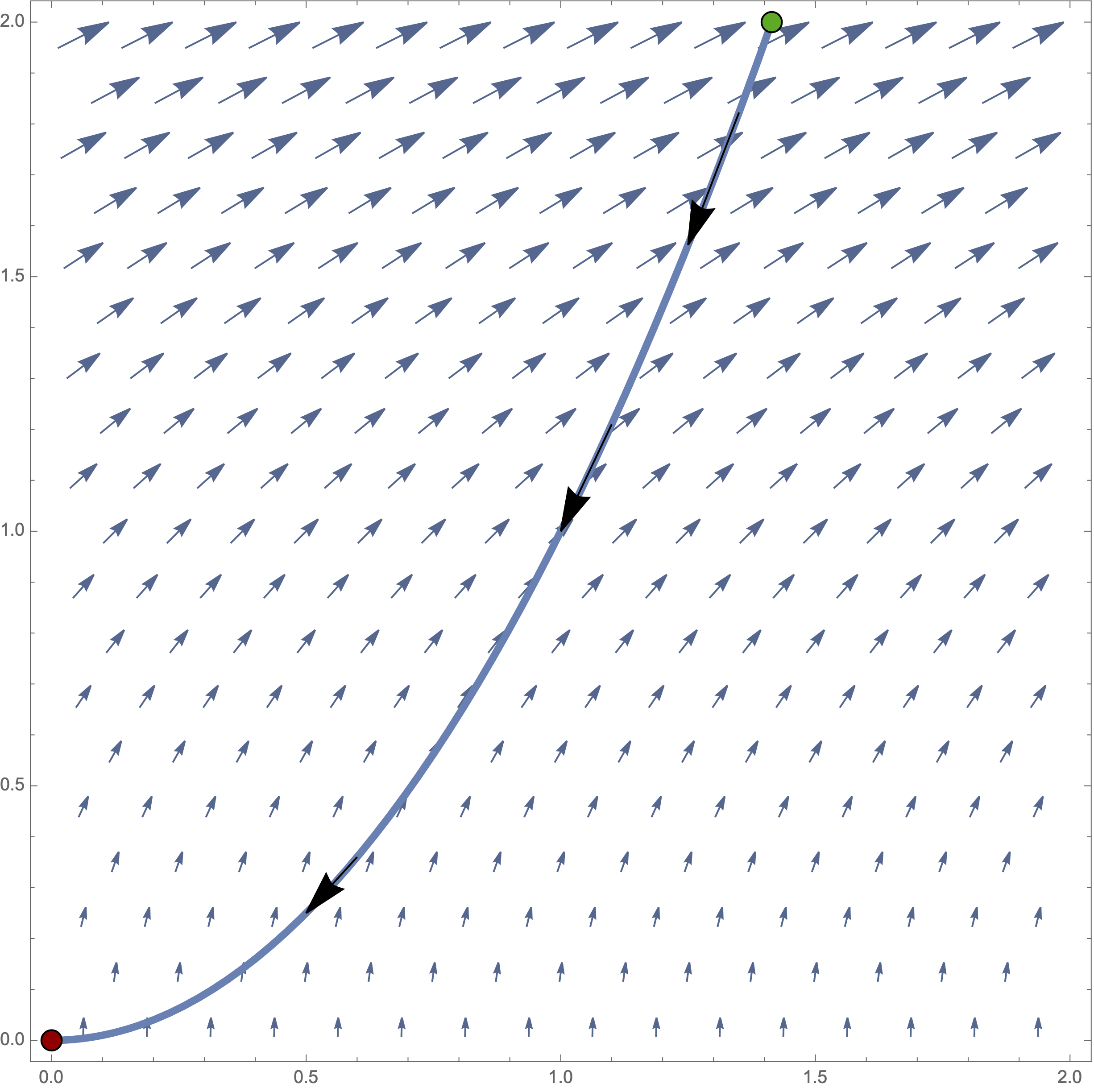
Consider the vector field \(\vec{F}\) and curve \(C\) shown in the figure below. Is \[\int_C \vec{F} \cdot d\vec{r}\] positive or negative? Why?
Use Green’s theorem to compute \[\oint_C 2x \, dx - x \, dy,\] where \(C\) is the positively oriented boundary of the rectangle with vertices \((0,0)\), \((3,0)\), \((3,2)\), and \((0,2)\).
Let \(\vec{F}\) denote the conservative vector field \[\vec{F}(x,y) = \left\langle 2 x y^3+1,3 x^2 y^2+1\right\rangle.\] Find a potential function \(f\) for \(\vec{F}\) and use it to compute \[\int_C \vec{F}\cdot d\vec{r},\] where \(C\) is a path from the origin to the point \((1,1)\).
Let \[\vec{F}(x,y,z) = \langle x, y, z^2 \rangle.\] Use the divergence theorem to compute \[\int_S \vec{F}\cdot d\vec{n},\] where \(S\) is the surface of the outward oriented unit cube.
Let \(E\) denote the positively oriented ellipse \(x^2 + 4y^2 = 4\).
- Set up and evaluate the integral \[\oint_E 0 \, dx + x \, dy.\]
- Use Green’s theorem to interpret your integral computation in terms of area.
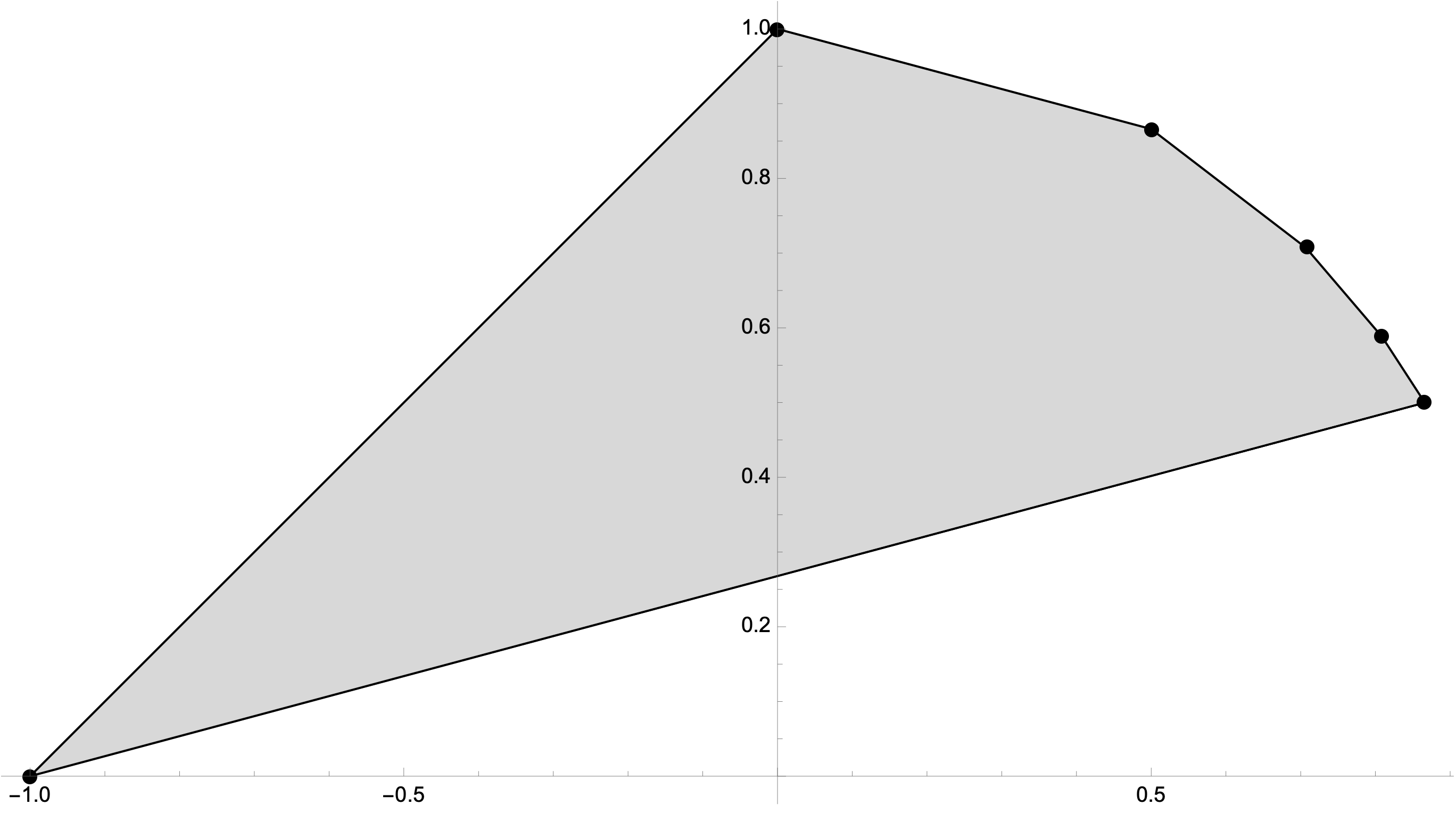
The polygon shown in Figure 2 has six vertices and six edges. Thus, I guess it’s an irregular hexagon. Its edges are at the points \[ (\cos(i \pi/6),\sin(i \pi/6)), \: \text{ for } \, i = 1\ldots 6. \] Write down a formula for the area of the polygon in terms of the vertices.
I think it might make a lot of sense to use a summation notation here.The equi-rectangular projection is the cylindrical projection defined by \(T(\varphi ,\theta )=(\theta ,\varphi )\). Compute the general distortion factors \(M_p\) and \(M_m\) for \(T\) as functions of \(\varphi\) and \(\theta\). Use this to explain why the equi-rectangular projection is neither conformal nor equal area.
Mercator’s projection is the cylindrical projection defined by \(T(\varphi ,\theta )=(\theta ,\ln (|\sec (\varphi )+\tan (\varphi )|))\). Compute the general distortion factors \(M_p\) and \(M_m\) for \(T\) as functions of \(\varphi\) and \(\theta\). Use this to prove that Mercator’s projection is conformal.
Lambert’s equal area, cylindrical projection is the cylindrical projection defined by \(T(\varphi ,\theta )=(\theta ,\sin (\varphi ))\). Compute the general distortion factors \(M_p\) and \(M_m\) for \(T\) as functions of \(\varphi\) and \(\theta\). Use this to prove that Lambert’s projection is equal area.
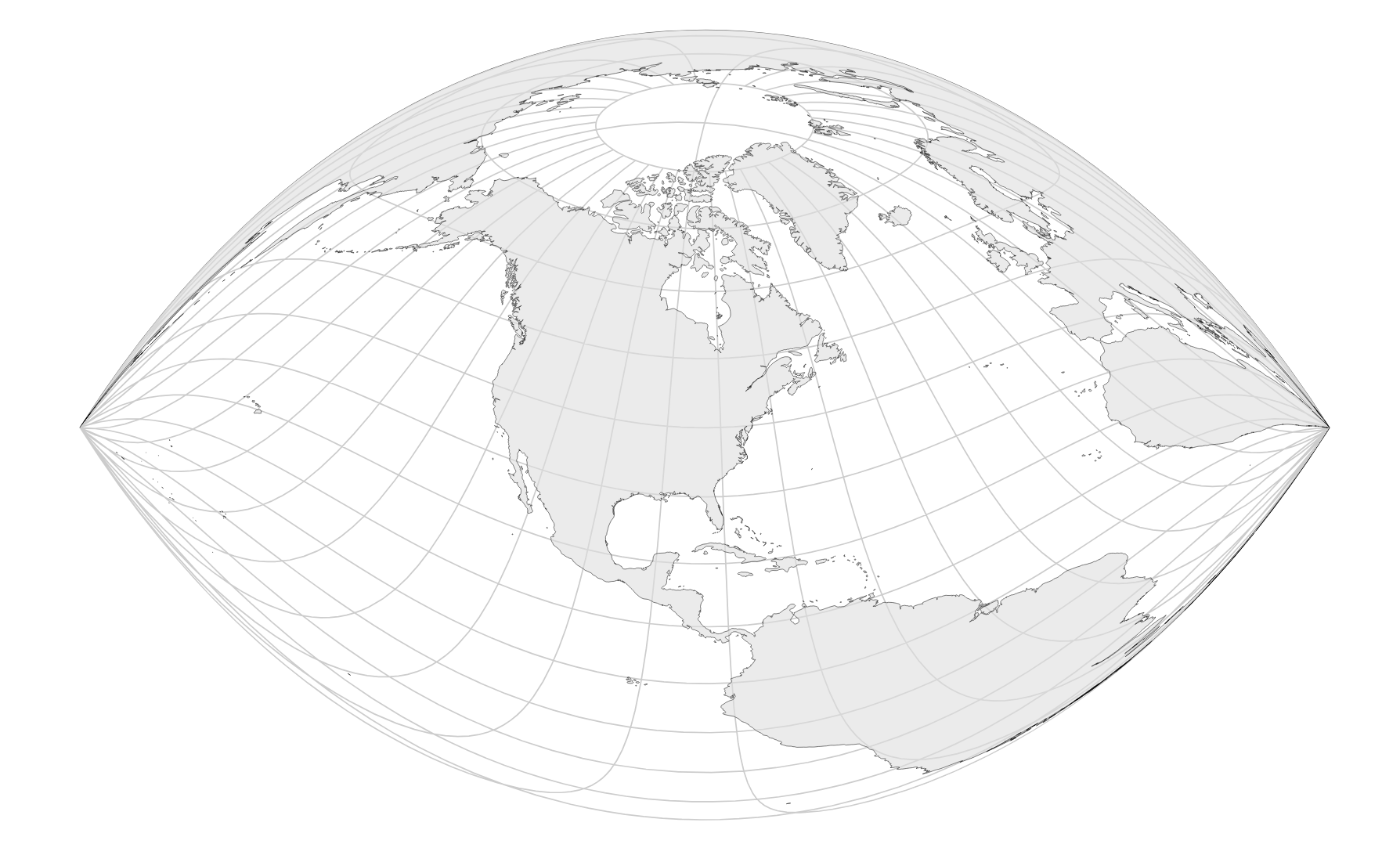
The Craig retroazimuthal projection with the standard graticule is shown in Figure 3. Is this map conformal? State clearly exactly why or why not.
Images
Your questions and answers
If you’d like to ask a question about or reply to a question on this sheet, you can do so by pressing the “Reply on Discourse” button below.