mark
You can ask questions over our Review for Exam II by posting them here!


You can ask questions over our Review for Exam II by posting them here!

I need help and a clear and concise walkthrough of questions 10-13. I went to the math lab and still do not really understand spherical coordinates very well as well as real numbers.
Let's try to keep it one question at a time, please.
Also, try to state the problem to the best of your ability, remembering that you can copy the code to create typeset mathematics right out of the online version of the review sheet, as described in this meta post.
Finally, if you can give some indication of what you've tried and where you're stuck, then it can be a lot easier for anyone to respond.
OK, here's what #11 says:
Let D denote the three-dimensional domain above the cone z=\sqrt{x^2+y^2} and inside the sphere x^2+y^2+z^2\leq 4. Evaluate
\displaystyle \iiint\limits_{D} (x^2 + y^2 + z^2) \, dV.
Why is z=\sqrt{x^2+y^2} a cone? And what does the whole domain look like? How do I use that to set up the integral?
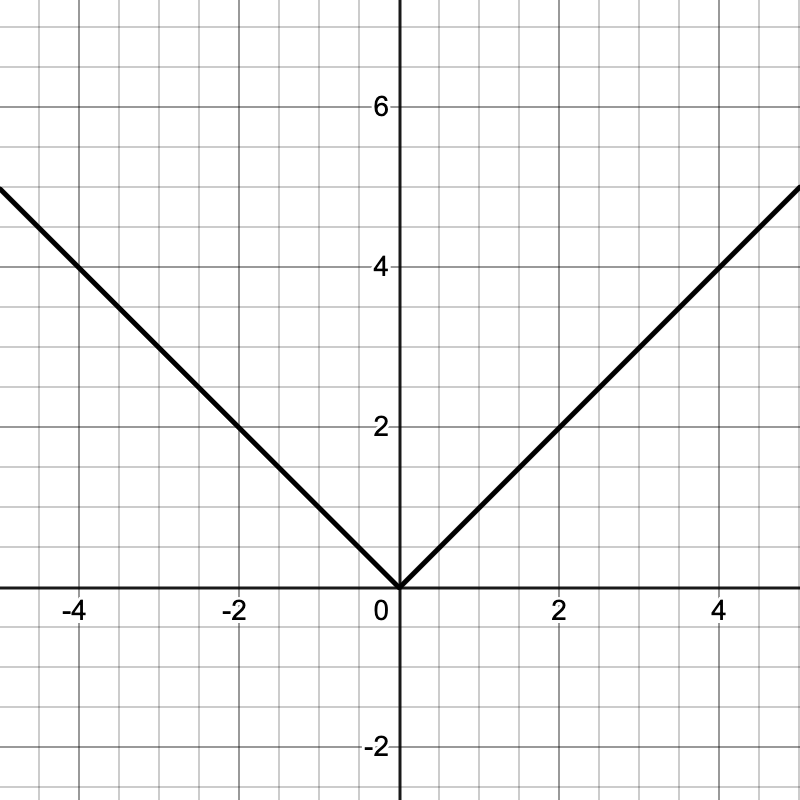
Seems like fair questions! To see why the graph of z=\sqrt{x^2+y^2} is a cone, let's slice it with a vertical plane by setting y=0. We're then left with
We know what the graph of that looks like, of course:
Since the function depends only on x^2+y^2, it has rotational symmetry so we get a cone centered about the z-axis. The implications for the bounds of integration are that
The other bounds of integration are pretty easy, so that our triple integral expressed in spherical coordinates are
Can you integrate that??

For question 6b, do does this integral look right?
Yes, that looks great!
Is #9 asking for the volume bounded by the xy plane and the function? I can't quite figure out what my bounds are based on the information provided
Yes, the intention is for you to set up the triple integral over the region R stuck between the xy-plane and the graph of
Thus, the statement of the problem is really incomplete.
The integrand, of course, is (x^2+y^2)z, which is a completely different function. You might think of that function as representing density over the region R so that the value of the integral could represent mass - not volume.
Well, there are a couple of functions in the statement of the problem

For question #9, I used polar coordinates to set up a triple integral and I got
Is this right?
Yes, that looks great - so far.
Reading the question, I guess you are asked to evaluate the integral. I don't think that part is particularly hard, in this case, but do be sure to answer the question that is asked on the exam!
Yes! I just wanted to make sure it was the correct integral, thanks 

If it's something you can answer, will Linear Regression be on exam 2? I'm not actually sure when we covered it.
No. We did cover it since the last exam and it was on the last quiz. With all the material we've covered, though, I decided not to put it on the review sheet so it won't be on this exam.
It seems like a good possibility for the final, though.