mark
Show that Green's area formula yields the correct result for a rectangle.


Show that Green's area formula yields the correct result for a rectangle.

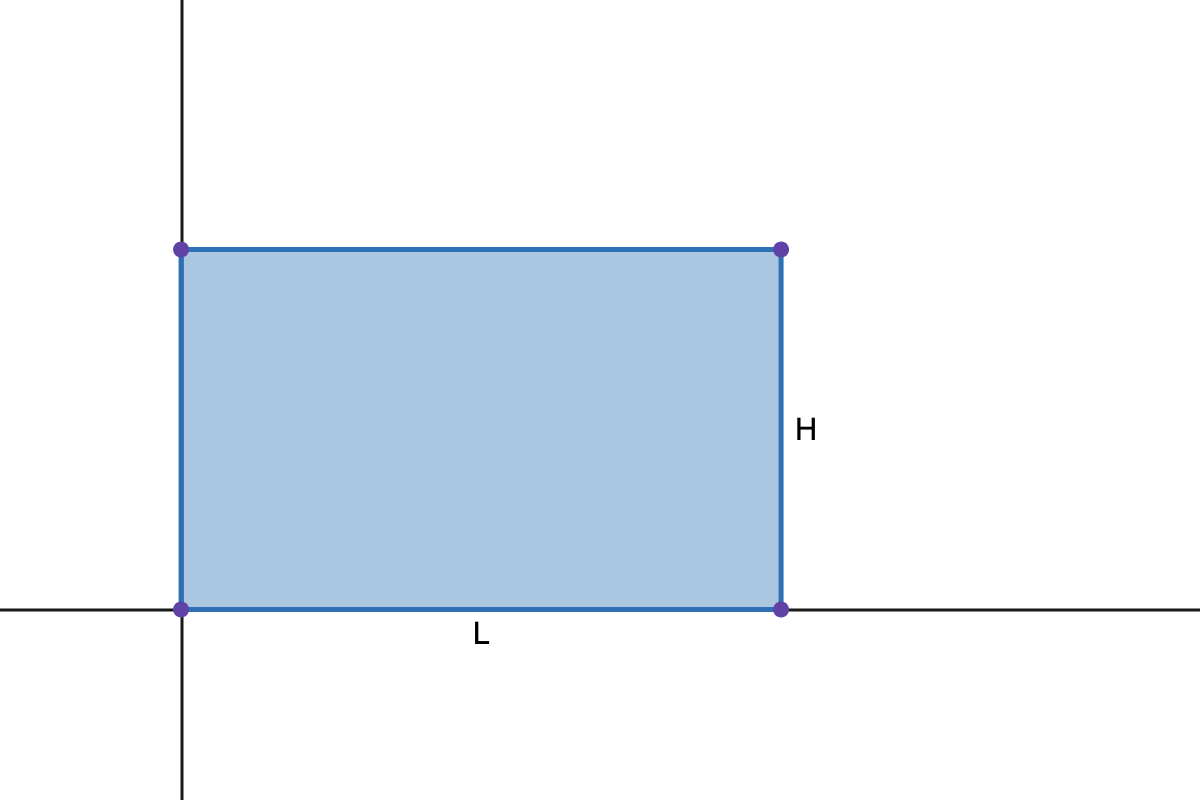
We know the area of the rectangle should equal L \times H. Using Green's theorem, we let our points from first to last in counter-clockwise order be (0,0), (L,0), (L,H), and (0,H).
Then our area equation takes the form
which is equal to \frac{1}{2}\bigl(0 + (2L)(H) + 0 + 0\bigr) = \frac{1}{2}(2L)(H), which is ultimately L \times H.
This proves that Green's Area formula yields the correct result for a rectangle.
@User 005 I think that looks probably pretty good. Did you try the AI Proofreader to see if it would typeset the mathematics more betterly?

To use Green's area formula on this rectangle, we must first recall the formula:
Using this, we plug in the coordinates of each corner of the rectangle moving in a counter‑clockwise direction until returning to the first point. The four points at hand are (0,0),\, (L,0),\, (L,H),\, (0,H).
It's important to note that when i = n, the i+1 refers to the first vertex.
Application of the formula to these points yields:
This simplifies to (1/2) \cdot 2 L H, which becomes L H.
We know that the area of a rectangle is equal to base times height, supporting the Green's area formula solution for this rectangle.
(Ai would not help the formula look any better unfortunately).
I'm not sure what AI tool you were using but I applied the built-in AI proofreader and it typeset your post as it looks now.
@User 005 I'm not sure how I saw Bennet_M's reply before yours but they both look good! I did apply the AI proofreader to yours as well.