Archived May, 2026.

Generate a linear regression

mark

(10 pts)

For this problem, you're going to use Desmos to generate a linear regression, compute the total squared error, and share your result here showing your computation and Desmos graph.

To begin, you need a little data. Your data will look

\{(0,1),(1,0),(F,L)\},

where F is the position in the alphabet of your first initial mod 10 and L is the position in the alphabet of your second initial mod 10.

For example, my initials are MM and M is the 13^{\text{th}} letter in the alphabet. Thus, my data is

\{(0,1),(1,0),(3,3)\},

Be sure to respond with

  • the equation of your regression line,
  • the computation of the total squared error, and
  • Desmos's rendering of the situation.
mark

My initials are MM, so my third point is (3,3), and my data is

\{(0,1),\;(1,0),\;(3,3)\}.

My regression is y = 0.785714x - 0.285714. The total squared error is therefore

E = (0.785714\times 0 - 0.285714 - 1)^2 + (0.785714\times 1 - 0.285714 - 0)^2 + (0.785714\times 3 - 0.285714 - 3)^2.
User 010

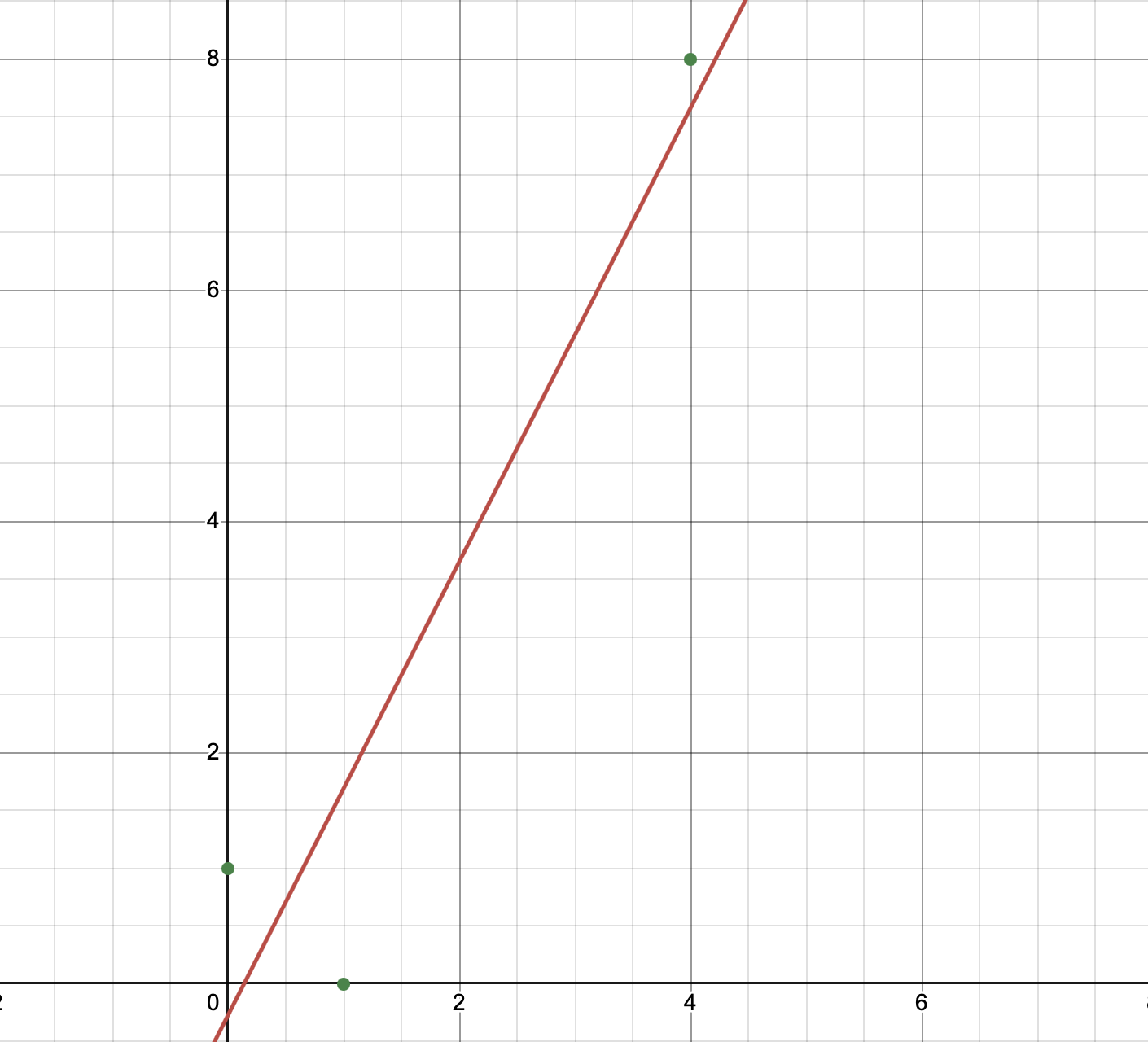
My initials are MS, so my third point is going to be (3,9). My data is going to be

\{(0,1),(1,0),(3,9)\}.

My regression is y = 2.92857x - 0.571429. Therefore, the total squared error is:

\begin{aligned} E &= (2.92857 \times 0 - 0.571429 - 1)^2 \\ &\quad + (2.92857 \times 1 - 0.571429 - 0)^2 \\ &\quad + (2.92857 \times 3 - 0.571429 - 9)^2 \end{aligned}

My Desmos rendering of the situation is:

User 011

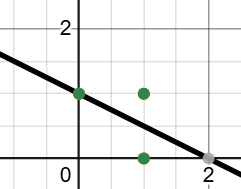
My initials are AA so my third point is (1,1) and my data is
\{(0,1),(1,0),(1,1)\}.

My regression is y=-0.5x+1.
The total squared error is

E=(-0.5\cdot0+2-1)^2+(-0.5\cdot1+2-0)^2+(-0.5\cdot1+2-1)^2.

Desmos rendering:

User 012

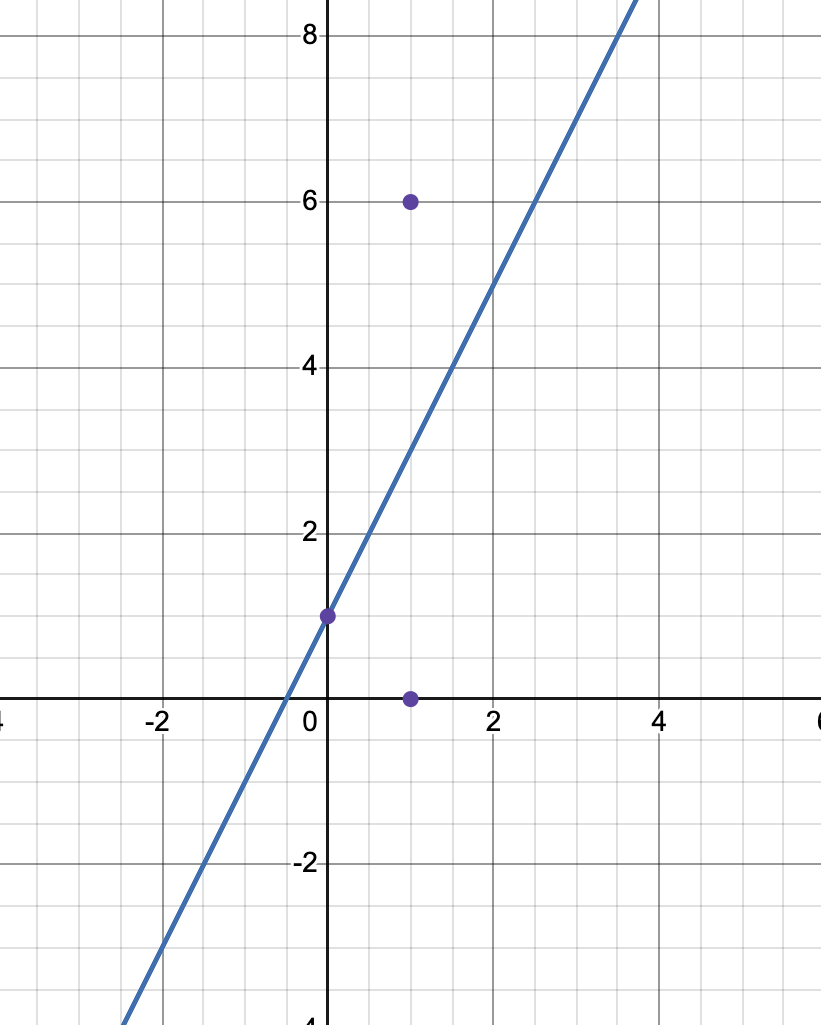
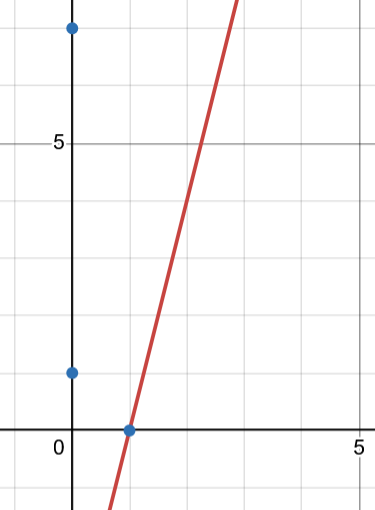
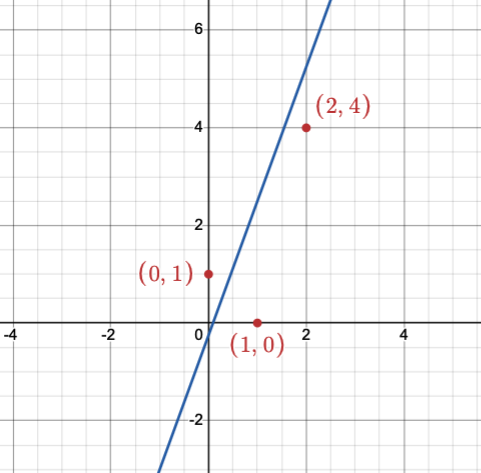
My initials are AZ so my third point is (1,6) and my data is

\{(0,1),(1,0),(1,6)\}

My regression line is y = 2x+1. The total squared error is therefore,

E = (2\times 0 + 1 - 1)^2 + (2\times 1 + 1 - 0)^2 + (2\times 1 + 1 - 6)^2

My Desmos image looks like this:

User 013

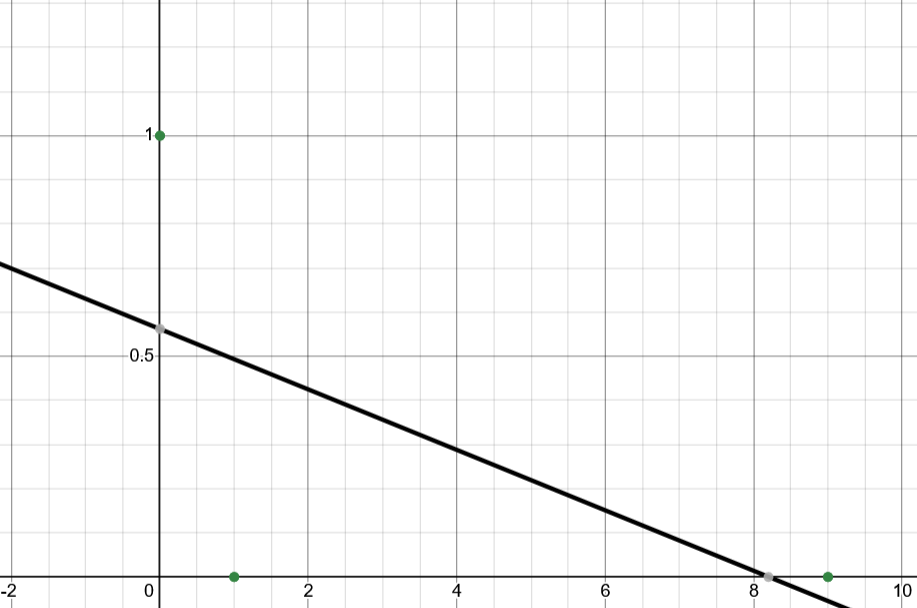
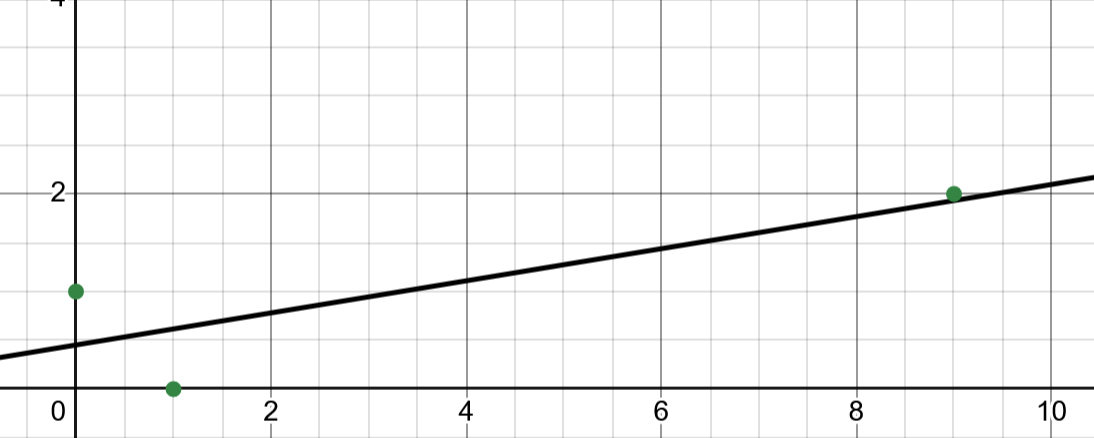
My initials are ST, so my third point is (9,0) and my data is

\{(0,1),\,(1,0),\,(9,0)\}.

My regression line is y = -0.0684932\,x + 0.561644 and the total squared error is

\begin{aligned} E &= (-0.0684932 \cdot 0 + 0.561644 - 1)^2 + (-0.0684932 \cdot 1 + 0.561644 - 0)^2 + (-0.0684932 \cdot 9 + 0.561644 - 0)^2. \end{aligned}

User 014

My initials are OC, so my third point is (5, 3). My data is:

\{(0, 1), (1, 0), (5, 3)\}

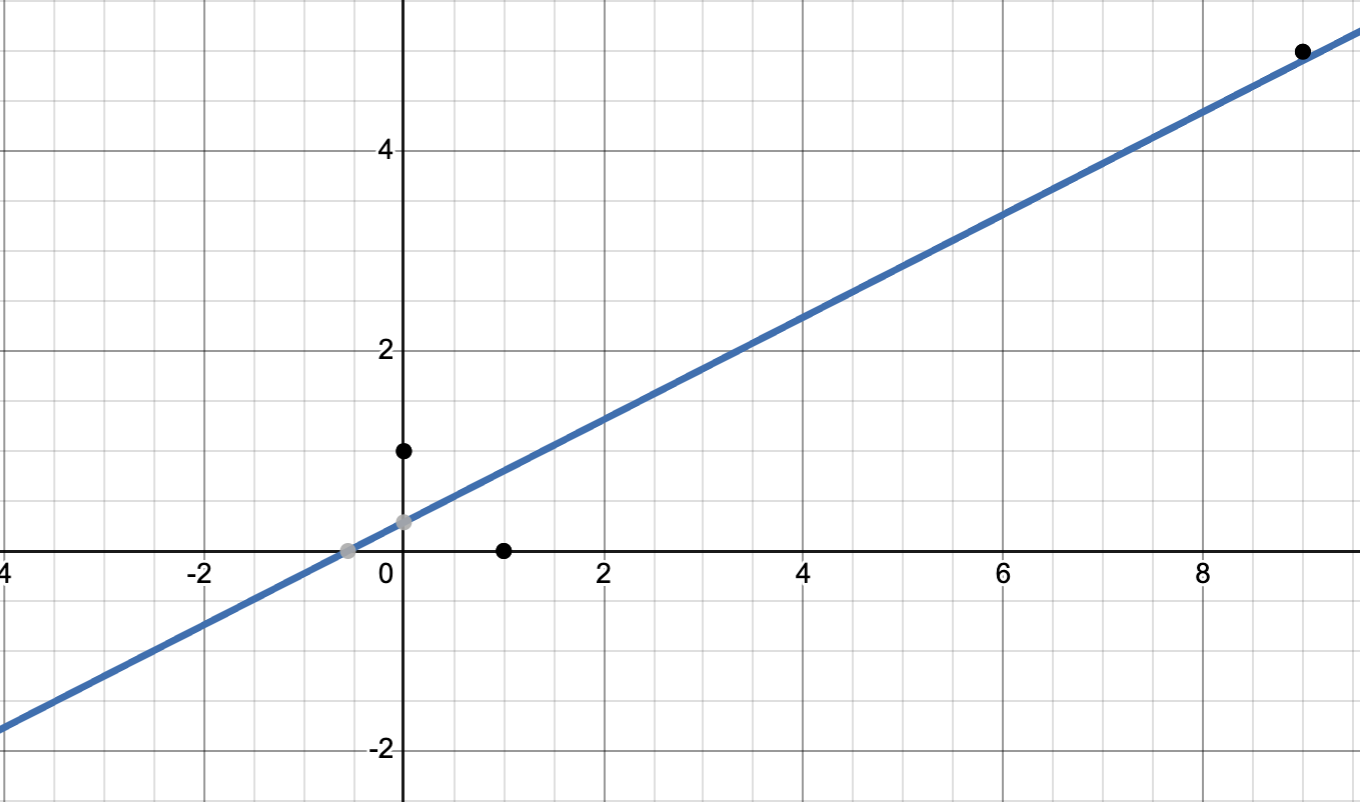
My regression is y = \frac{1}{2}x + \frac{1}{3}, so my total squared error is:

E = (\frac{1}{2} \times 0 + \frac{1}{3} - 1)^2 + (\frac{1}{2} \times 1 + \frac{1}{3} - 0)^2 + (\frac{1}{2} \times 5 + \frac{1}{3} - 3)^2

My Desmos rendering of the situation is:

User 015

My initials are FV so my third point is (6,2) and my data is:
\{(0,1),(1,0),(6,2)\}.

My regression is y = 0.241935x + 0.435484. The total squared error is therefore

E = (0.241935(0) + 0.435484 - 1)^2 + (0.241935(1) + 0.435484 - 0)^2 + (0.241935(6) + 0.435484 - 2)^2.

My Desmos rendering:

User 016

My initials are EV, so my 3rd point is (5,2) and my data is

\{(0,1),(1,0),(5,2)\}

My regression line is y=0.285714x+0.428571. The total squared error is therefore,

E=\bigl( 0.285714\cdot0+0.428571-1 \bigr)^2+\bigl( 0.285714\cdot1+0.428571-0 \bigr)^2+\bigl( 0.285714\cdot5+0.428571-2 \bigr)^2.

My Desmos rendering of the situation is:

User 017

My initials are JH, so after mod ten my third point is (0,8). My data is

\{(0,1),\,(1,0),\,(0,8)\}

My regression is y=-4.5x+4.5. The total squared error looks like

E=(-4.5\cdot0+4.5-1)^2 + (-4.5\cdot1+4.5-0)^2 +(-4.5\cdot0+4.5-8)^2
E=(3.5)^2 + (0)^2 + (-3.5)^2
E=12.25+12.25
E=24.5
User 018

My data looks like

\{(0,1),(1,0),(5,9)\},

my regression is therefore y = 1.78571x - 0.238095.

The total squared error is thus

\begin{aligned} E &= (1.78571 \cdot 0 - 0.238095 - 1)^2 + (1.78571 \cdot 1 - 0.238095 - 0)^2 \\ &\quad+ (1.78571 \cdot 5 - 0.238095 - 9)^2 \end{aligned}

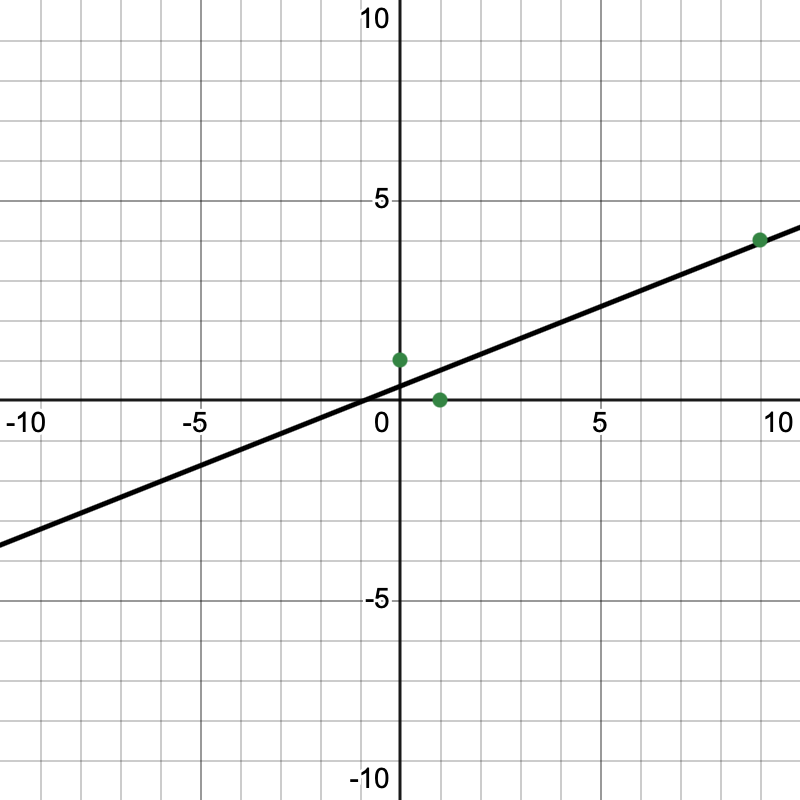
My desmos graph is: Desmos | Graphing Calculator

User 019

My intials are SD so my thrid point is (9,4) and my data is

\{(0,1),(1,0),(9,4)\}.

My regression is y = 0.39726x + 0.342466

Let E = (0.39726 \cdot 0 - 0.342466)^2 + (0.39726 \cdot 1 - 0.342466 - 0)^2 + (0.39726 \cdot 9 - 0.342466 - 4)^2.

User 008

My initials are KO, so my third point is (8,3), and my data is
\{(0,1),\,(1,0),\,(8,3)\}.
My regression is y = 0.315789x + 0.38596. The total squared error is therefore

\begin{aligned} E &= (0.315789\times0 + 0.38596 - 1)^2 + (0.315789\times1 + 0.38596 - 0)^2 \\ &\quad + (0.315789\times8 + 0.38596 - 3)^2.\end{aligned}

User 020

My initials are SV, so my third point is (9,2), and my data is

\{(0,1),(1,0),(9,2)\}.

My regression line is y=0.164384x+0.452055. Therefore, my total squared error is:

E=(0.164384(0)+0.452055-1)^2 + (0.164384+0.442055-0)^2+(0.164384(9)+0.452055-2)^2.

Here is the desmos image:

User 021

My initials are AW, making my 3rd point (1,3) and my data set

\{(0,1),\;(1,0),\;(1,3)\}.

My regression is y = 0.5x + 1 and my total squared error is

E(0.5,1) = (0.5\cdot0 + 1 - 1)^2 + (0.5\cdot1 + 1 - 0)^2 + (0.5\cdot1 + 1 - 3)^2.
User 003

My initials are NL, so my third point was (4,2), and my data set is

\{(0,1),\;(1,0),\;(4,2)\}

My regression is y=0.346154x+0.423077. The total squared error is

E = (0.346154\times0+0.423077-1)^2 +(0.346154\times1+0.423077-0)^2 +(0.346154\times4+0.423077-2)^2
audrey

My initials are AM. A is the first letter in the alphabet and M is the 13^{\text{th}}. Thus, my data is

\{(0,1), (1,0), (1,3)\}.

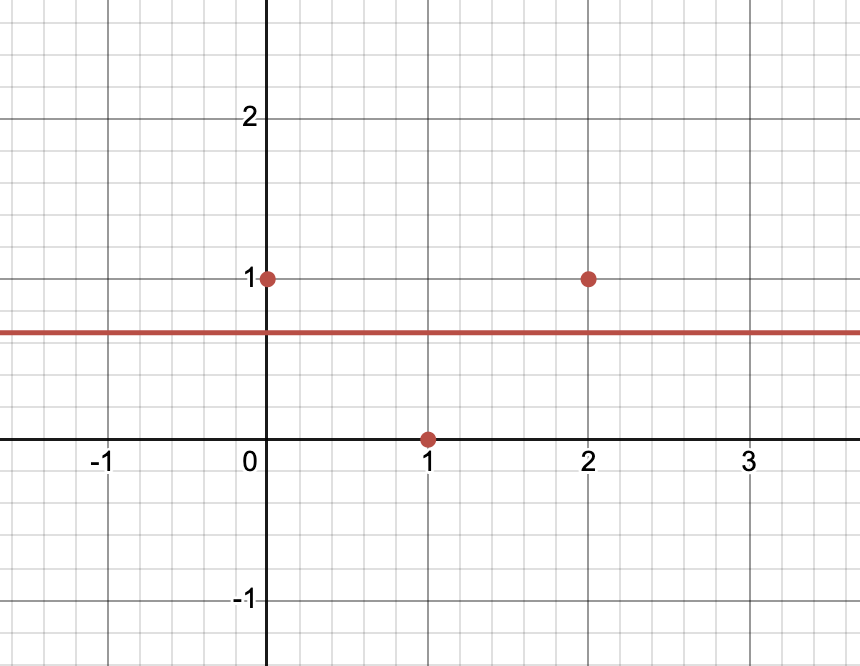
My regression line is y=0.5x+1 and the picture looks like so:

My error is

E = (0.5\cdot0 + 1 - 1)^2 + (0.5\cdot1 + 1 - 0)^2 + (0.5\cdot1 + 1 - 3)^2.
User 022

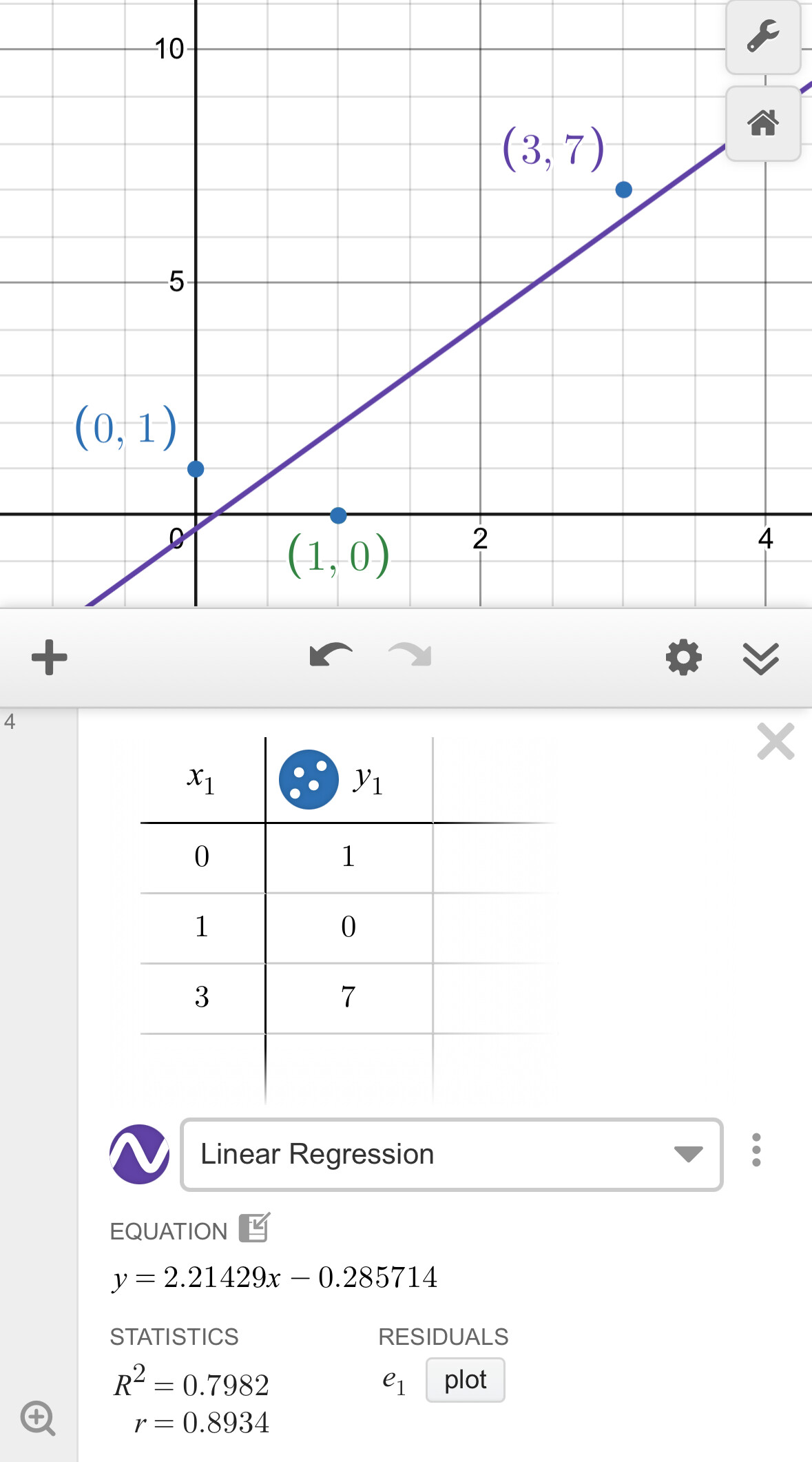
My initials are MQ, so my third point is (3,7), and my data is

\{(0,1),\,(1,0),\,(3,7)\}

My regression is y = 2.214x - 0.429. The total squared error is therefore

E = (2.214\times0 - 0.429 - 1)^2 + (2.214\times1 - 0.429 - 0)^2 + (2.214\times3 - 0.429 - 7)^2.

User 009

My 1st and 2nd initials are JW, so the third data point is (0,3), and my data is

\{(0,1),(1,0),(0,3)\}.

My regression is y=-2x+2. The total squared error is, therefore,

E\left(a,b\right)\ =\left(\ -2\cdot0+2-1\right)^{2}+\left(-2\cdot1+2-0\right)^{2}+\left(-2\cdot0+2-3\right)^{2}
User 023

My initials are DL, so my third point is (4,3), and my data is

\{(0,1),\;(1,0),\;(4,3)\}.

My regression is y = 0.615385x + 0.307692. The total squared error is therefore

\begin{aligned} E &= (0.615385\times 0 - 0.307692 - 1)^2 \\ &\quad + (0.615385\times 1 - 0.307692 - 0)^2 \\ &\quad + (0.615385\times 4 - 0.307692 - 3)^2. \end{aligned}

User 024

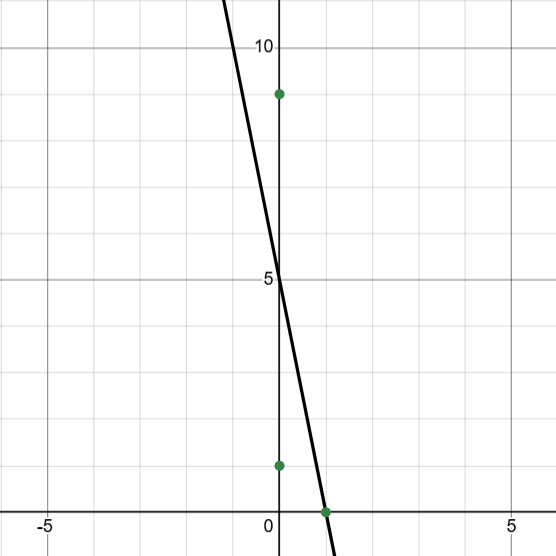
My initials are AH so my third point is at (1,8).
My regression line is y = 3x + 1.
The total square error would be calculated like

E = (3\cdot0+1-1)^2 + (3\cdot1+1-0)^2 + (3\cdot1+1-8)^2 = 32.

In desmos it looks like

User 004

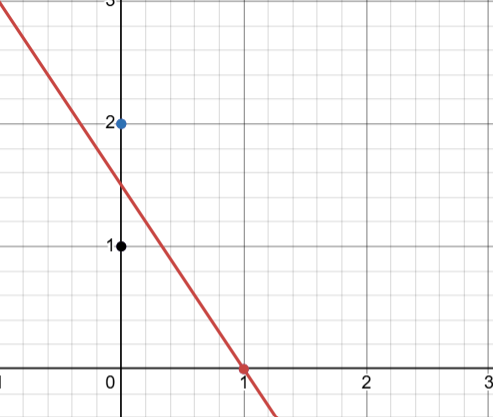
My initials are JB, my third point after mod 10 is (0,2). My data set is

\{(0,1),(1,0),(0,2)\}

My regression equation is y=(-1.5x)+1.5
My total squared error is

E=(-1.5\cdot 0+1.5-1)^2+(-1.5\cdot 1+1.5-0)^2+(-1.5\cdot 0+1.5-2)^2=0.5

Here is my graph on desmos:

User 002

My initials are AM. A is the first letter in the alphabet and M is the 13th. Thus, my data is

\{(0,1),(1,0),(1,3)\}.

My regression line is y = 0.5x + 1 and the picture looks like this:

My error looks like this:

E = (0.5\cdot 0+1-1)^2+(0.5\cdot 1+1-0)^2+(0.5\cdot 1+1-3)^2
User 025

My initials are KM, so my third point is (1,3). Therefore my data is:

\{(0,1), (1,0), (1,3)\}

My regression line is y=0.5x+1. The total squared error therefore is:

E = (0.5 + 1)^2 + (0.5 + 1 - 3)^2
User 026

My initials are OX, so my third point is (5,4), and my data is

\{(0,1),(1,0),(5,4)\}

My regression is y = 0.714286x + 0.238095. The total squared error is therefore

E = (0.714286 \cdot 0 + 0.238095 - 1)^2 + (0.714286 \cdot 1 + 0.238095 - 0)^2 + (0.714286 \cdot 5 + 0.238095 - 4)^2
User 007

My initials are ZO. My first initial is the last letter in the alphabet and my last initial is the 15th letter in the alphabet. My points are:

\{(0,1),\;(1,0),\;(6,5)\}

This is the equation of my regression line:

y = 0.774194x + 0.193548

This is my total squared error:

E = (0.774194\times 0 + 0.193548 - 1)^2 + (0.774194\times 1 + 0.193548 - 0)^2 + (0.774194\times 6 + 0.193548 - 5)^2
User 027

My initials are TS. T is the 20th letter of the alphabet, and S is the 19th letter of the alphabet. Therefore my data set is:

\{(0,1),(1,0),(0,9)\}

My line of best fit is y = -5x + 5.

The total squared error is:

E = (-5\cdot0+5-1)^2+(-5\cdot1+5-0)^2+(-5\cdot0+5-9)^2

Here is my image in Desmos:

User 028

My initials are HN. H is the eighth letter in the alphabet and N is the 14th.

My data is

\{(0,1),(1,0),(8,14)\}.

The equation of my regression line is y = 1.76316x - 0.289474 and the graph looks like this:

E = (-0.289474 - 1)^2 + (1.76316 - 0.289474 + 1)^2 + (8(1.76316) - 0.289474 - 14)^2
User 029

My initials are AD, so my third point is (1,4), and my data is

\{(0,1),(1,0),(1,4)\}

My regression is y=1x+1, and the total squared error is

E=(1\cdot0+1-1)^2+(1\cdot1+1-0)^2+(1\cdot1+1-4)^2
User 030

My initials are CB, so my points are

{(0,1),(1,0),(3,2)}

My equation is

y=.428571x+0.428571

E(0.428571, 0.428571)= (.428571-1)+(.428571+.428571)+(3(.428571)+.428571-2)

User 031

My initials are OF so my data points are

\{(0,1),(1,0),(1,3)\}.

My regression line is y=1.14286x+0.047619.

My error is:

E = (1.14286\cdot 0+0.047619-1)^2+(1.14286\cdot 1+0.047619-0)^2+(1.14286\cdot 5+0.047619-6)^2
User 032

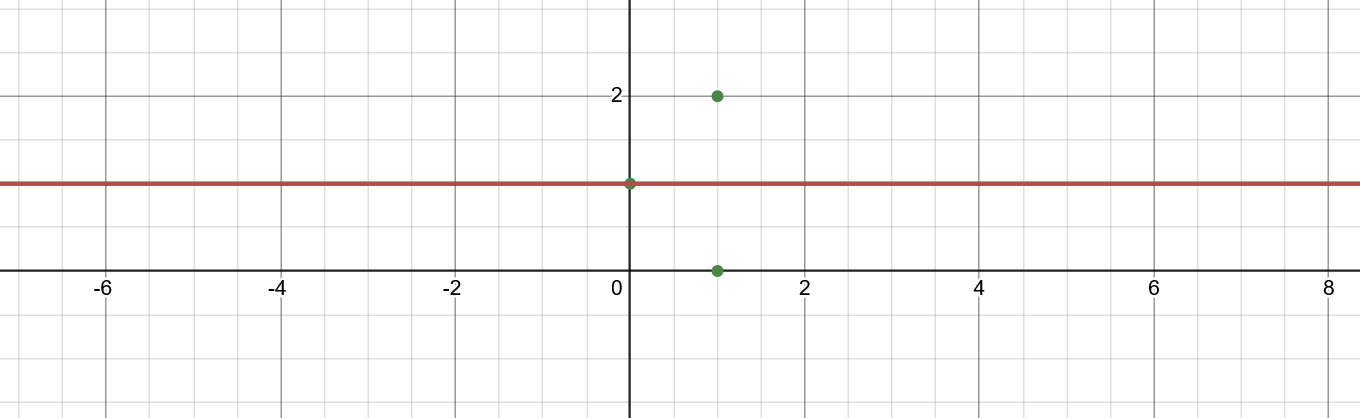
My first name initial is A and my middle name initial is L. A is the first letter in the alphabet and L is the 12th, so my data is
\{(0,1),(1,0),(1,2)\}. My total squared error is as follows: \left(b-1\right)^{2}+\left(a+b\right)^{2}+\left(a+b-2\right)^{2}.
My regression line is y=0x+1, and my graph looks like this:

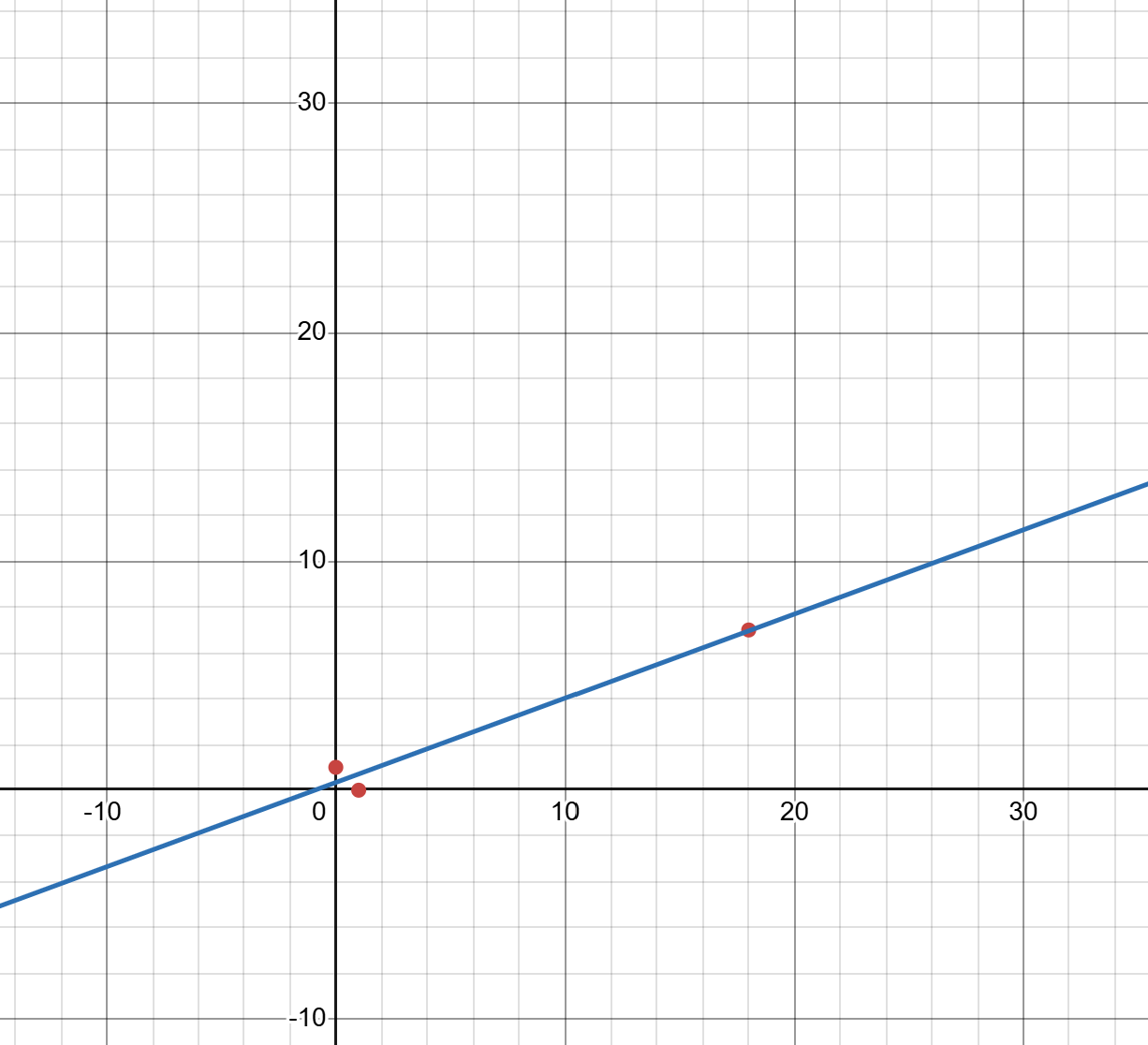
User 033

My initials are RG, so my third point is (18,7)

My regression is y = 0.336 + 0.368x

The total error is

E=(0.336(0)+0.368-1)^2+(0.336(1)+0.368-0)+(0.336(18)+0.368-7)^2

User 034

My initials are JG, so my point is (0,7).

Making my data \{(0,1),(1,0),(0,7)\}.

My regression is y = 4x - 4.

So my total squared error is

E = (4\times 0 - 4 - 1)^2 + (4\times 1 - 4 - 0)^2 + (4\times 0 -4 - 7)^2.

User 035

My initials are AS: A is the 1st letter of the alphabet, and S is the $19$th.

My data is:

\{(0,1),\ (1,0),\ (1,9)\}

My regression line is: y=3.5x+1.
The total squared error is:

(3.5(0)+1-(-1))^{2}+(3.5(1)+1-0)^{2}+(3.5(1)+1-9)^{2}.

User 036

My initials are LG, so my third point is (2,7), and my data is

{(0,1),;(1,0),;(2,7)}.

My regression is y = 3x - 0.33. The total squared error is therefore

E = (3\times 0 - 0.33 - 1)^2 + (3\times 1 - 0.330)^2 + (3\times 2 + .33 - 7)^2.

User 006

My initials are BM, with B being the second letter of the alphabet and A being the 1st.

Thus, my data is: \{(0,1),(1,0),(2,3)\}

My regression line is calculated by the equation: y=\left(b-1\right)^{2}+\left(b-0\right)^{2}+\left(b-1\right)^{2}

My computation for total squared error is: y=\left(b-1\right)^{2}+\left(b-0\right)^{2}+\left(b-1\right)^{2}

My line is shown on Desmos below.

User 037

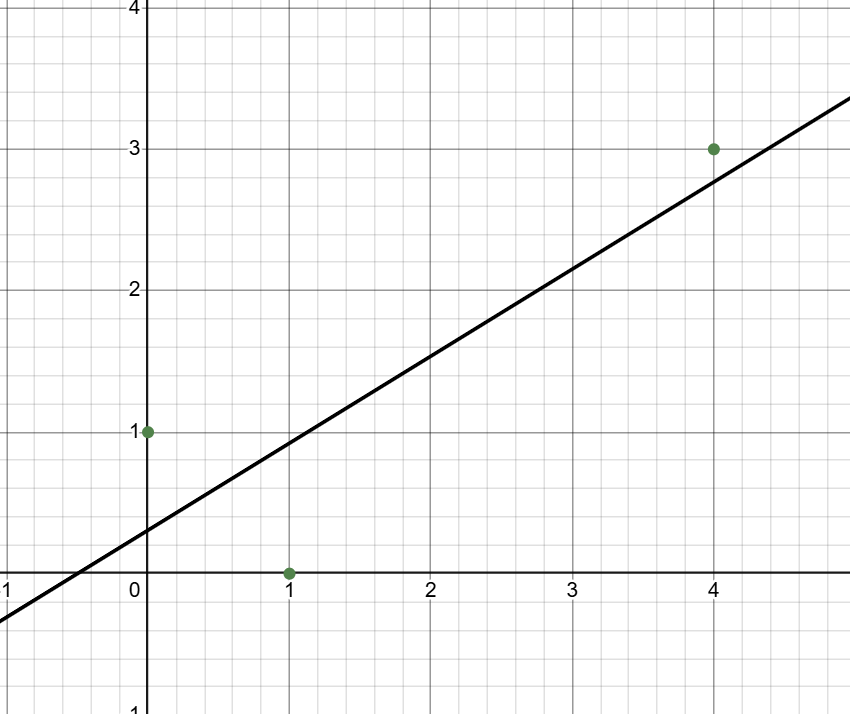
My initials are D A. My data points are {(0,1),(1,0),(4,1)}
The regression line is Y=.0769231x+.538462

The regression line looks like this:

And the error is

E=(.0769231*0+ .538462-1)^2 + (.0769231*1+.538462-0)^2+ (.0769231*4+.538462-1)^2
User 001

My initials are NC, 14, 3, so my points are (4, 3).

My graph looks like the following:

Regression line is Y = 0.615385x + 0.307692
so my error computed is (0.615385(4) + 0.307692 - 3)^2 + (0.615385(1) + 0.307692)^2 + (0.615385(0) + 0.307692 - 1)^2 = 1.38461538462

User 038

My initials are DH, so my points are {(0,1),(1,0),(4,8)}.
My linear regression is f(x)=1.96154x-0.269231 and my squared error is

E = (1.96154 \times 0 - 0.269231 - 1)^2 + (1.96154 \times 1 - 0.269231 - 0)^2 + (1.96154 \times 4 - 0.269231 - 8)^2.

User 039

f\left(x\right)=\frac{11}{4}x-\frac{1}{4}

E=\left(-\frac{1}{4}-1\right)^{2}+\left(\frac{11}{4}-\frac{1}{4}\right)^{2}+\left(\frac{22}{4}-\frac{1}{4}-4\right)^{2}

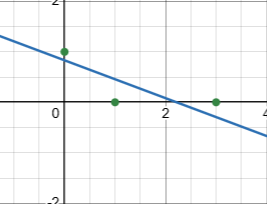
User 040

My initials are CJ, so my third point is (3,0) and my data set is
{(0,1),(1,0),(3,0)}.

My regression is y = −3x/8​ + 5/6

The total squared error is:

E = \left(-\frac{3}{8}(0)+\frac{5}{6}-1\right)^2 + \left(-\frac{3}{8}(1)+\frac{5}{6}-0\right)^2 + \left(-\frac{3}{8}(3)+\frac{5}{6}-0\right)^2

Desmos Rendering:

User 041

My initials are JW, so my third point is going to be (0, 4) and my data is

\{(0,1), (1,0), (0,4)\}.

My regression line is y=-2.5x+2.5 and the total squared error is

E=(-2.5(0)+2.5-1)^2+(-2.5(1)+2.5-0)^2+(-2.5(0)+2.5-4)^2

User 042

My initials are SY, so my third point is (5,9), and my data is

{(0,1),(1,0),(5,9)}.

My regression is y=0.513699x+0.287671.
The total squared error is therefore:
E=(0.513699⋅0+0.287671−1)^2+(0.513699⋅1+0.287671−0)^2+(0.513699⋅5+0.287671−9)^2

User 043

My initials are SA, so my third point is (9, 1), and my data is
{(0, 1), (1, 0), (9, 1)}.
My regression is y = 0.0479452x + 0.506849. The total squared error is therefore

E = (0.0479452 \cdot 0 + 0.506849 - 1)^2 + (0.0479452 \cdot 1 + 0.506849 - 0)^2 + (0.0479452 \cdot 9 + 0.506849 - 1)^2
User 044

My initials are RF. My data is {(0,1),(1,0),(8,6)}

My regression equation is: y = \frac{27}{38}x + \frac{23}{113}, so my total squared error is:

E = (\frac{27}{38}*0 + \frac{23}{113}-1)^2 + (\frac{27}{38}*1 + \frac{23}{113}-0)^2 + (\frac{27}{38}*8 + \frac{23}{113}-6)

My graph looks like:

mark