In class practice for exam 1
Here are a few more practice problems for our first exam this Friday.
Let’s suppose that we know that \[ \lim_{x\to -1} f(x) = 2 \text{ and } \lim_{x\to-1} g(x) = -3. \] What can you say about
\[\lim_{x\to-1} (4f(x)-2g(x))?\]Write down a complete sentence referring to the intermediate value theorem explaining why \[f(x)= \sqrt[3]{x} + \frac{1}{4}x - 2\] has a root between \(x=0\) and \(x=8\).
Find the derivatives of the following functions using the basic differentiation rules.
- \(f(x) = 4x^2 - 1\)
- \(f(x) = 42x^{18} - 3x^{15} + 5x^{4} - 10\)
- \(\displaystyle f(x) = \frac{x^4 - 2x^{5/2} - x + \sqrt{x}}{x^2}\).
Find the derivative of the following function, using the definition of the derivative: \[f(x) = 4x^2 - 1.\]
Let \(f(x) = 5x-x^2\).
- Sketch the graph of \(f\), together with the its tangent line at the point \(x=2\).
- Find a formula for the tangent line.
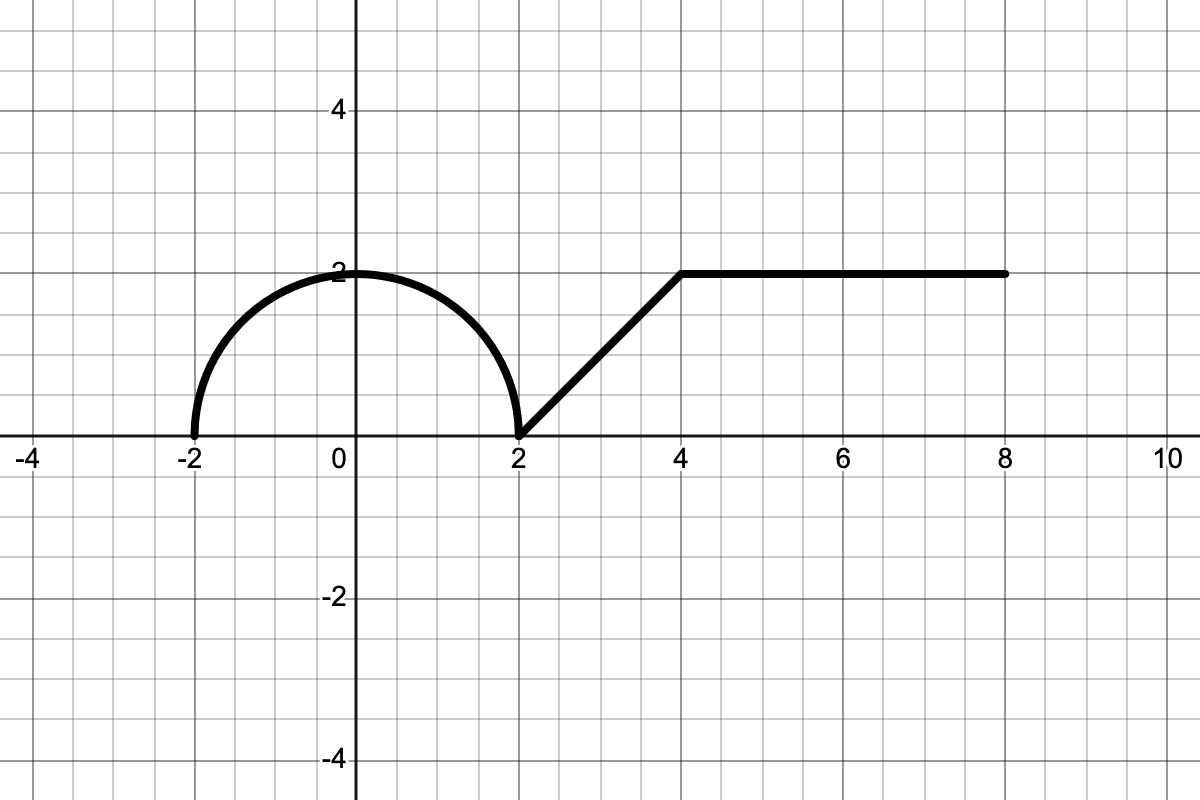
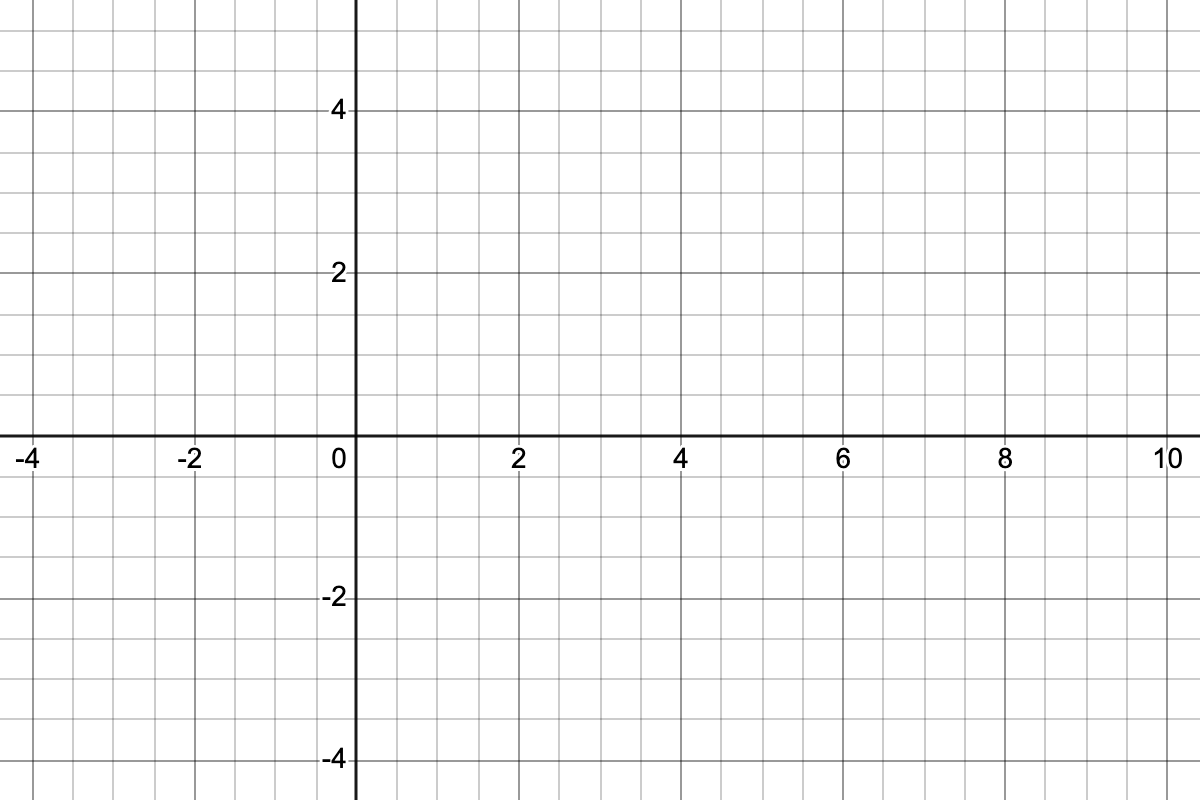
- The graph of the function \(f\) is shown in the top part of Figure 1 below. It consists of a semi-circle and two line segments. Sketch the graph of \(f'\) on the axes provided below the graph of \(f\).